Artificial Intelligence (AI) is transforming every industry — and finance is at the center of this revolution. From automated accounting software to AI-powered trading algorithms, technology is changing how financial work is done.
But the biggest question remains:
If you are a student, job seeker, finance professional, or business owner, this question is extremely important for your future.
In this fully detailed guide, we will explore:
- What AI really means in finance
- Which finance jobs are being replaced
- Which jobs are growing because of AI
- Future salary trends
- Skills you must learn
- How to protect your career
- Real-world examples
- Expert predictions for 2030 and beyond
Let’s dive deep.
What Is AI in Finance?
Understanding Artificial Intelligence
Artificial Intelligence (AI) refers to machines and systems that can perform tasks that normally require human intelligence. These include:
- Learning from data
- Pattern recognition
- Decision making
- Predicting outcomes
- Language processing
- Automation
In finance, AI systems analyze massive amounts of financial data much faster and more accurately than humans.
How AI Is Used in the Finance Industry
AI is already deeply integrated into financial systems. It is not “coming” — it is already here.
1. Automated Accounting
Accounting software like:
- QuickBooks
- Xero
- Zoho Books
use AI to:
- Categorize expenses
- Detect errors
- Generate invoices
- Prepare tax reports
Many small businesses no longer need full-time accountants for basic tasks.
2. AI in Banking
Major banks like:
- JPMorgan Chase
- HDFC Bank
- State Bank of India
use AI for:
- Fraud detection
- Loan approval automation
- Risk assessment
- Customer service chatbots
AI can analyze credit risk within seconds — something that used to take days
3. Algorithmic Trading
Investment firms use AI-powered trading systems that:
- Analyze stock patterns
- Predict market movements
- Execute trades in milliseconds
These systems reduce the need for traditional floor traders.
4. Fraud Detection and Cybersecurity
AI monitors millions of transactions in real time and flags suspicious behavior instantly.
Humans cannot process this volume of data manually.
5. Robo-Advisors
Platforms like:
- Betterment
- Wealthfront
provide automated financial advice without human advisors.
This affects entry-level financial advisor roles.
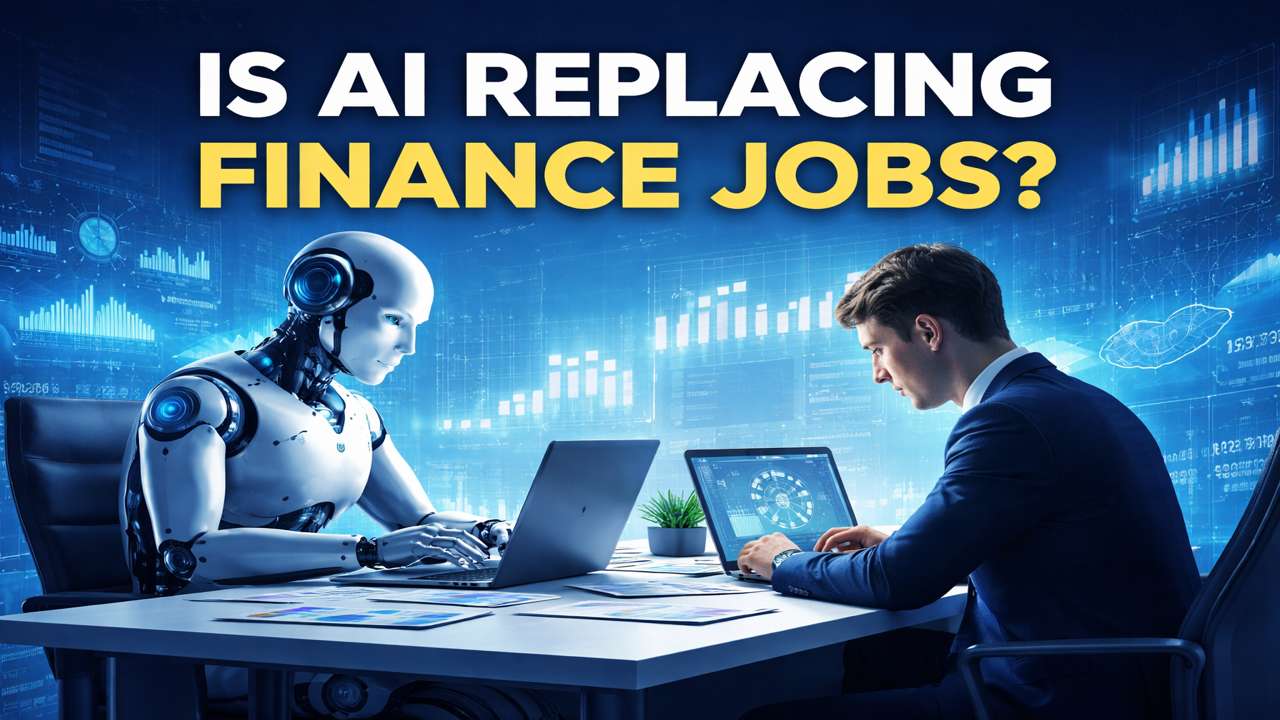
Is AI Replacing Finance Jobs?
Short Answer: Yes and No
AI is replacing repetitive and rule-based finance jobs.
But AI is also creating new, higher-paying finance roles.
The real impact depends on:
- Skill level
- Job type
- Industry
- Adaptability
Let’s analyze in detail.
Finance Jobs Most at Risk
1. Data Entry Clerks
Why at Risk?
AI software can:
- Extract data from invoices
- Process receipts
- Fill spreadsheets automatically
Manual data entry is declining rapidly.
2. Bookkeeping Roles
Basic bookkeeping tasks are automated through cloud accounting software.
Small businesses now manage books using AI tools.
3. Junior Accountants
Entry-level accounting roles involving:
- Invoice reconciliation
- Expense tracking
- Basic reporting
are increasingly automated.
4. Bank Tellers
With digital banking apps and ATMs, physical bank visits are decreasing.
Many banks are reducing branch staff.
5. Basic Financial Analysts
If the role involves:
- Collecting data
- Running simple financial models
- Creating repetitive reports
AI tools can perform these tasks faster.
Finance Jobs That AI Cannot Easily Replace
Now let’s discuss safe and growing careers.
1. Financial Strategy Roles
Strategic planning requires:
- Human judgment
- Market understanding
- Leadership
- Emotional intelligence
AI provides data, but humans make strategic decisions.
2. Relationship Managers
Corporate finance and wealth management depend on trust.
Clients prefer human interaction when managing large investments.
3. Risk Management Experts
While AI detects risk patterns, experienced professionals interpret them and decide actions.
4. Compliance Officers
Regulations change frequently.
Human expertise is required to understand laws and implement compliance strategies.
5. CFO and Leadership Roles
Top financial leaders:
- Make executive decisions
- Manage teams
- Communicate with investors
AI assists — but does not replace — leadership.
How AI Is Creating New Finance Jobs
AI does not only eliminate jobs — it creates new ones.
1. AI Financial Analyst
Professionals who understand:
- Finance
- Data science
- AI tools
are in high demand.
2. FinTech Specialists
Financial Technology (FinTech) companies are growing rapidly.
Examples include:
- Paytm
- PhonePe
- Stripe
These companies need finance professionals who understand AI systems.
3. Financial Data Scientists
This is one of the highest-paying finance careers.
Professionals analyze large datasets to guide investment and risk decisions.
4. AI Model Auditors
As AI becomes powerful, companies need experts to:
- Check AI fairness
- Ensure compliance
- Reduce bias
This is a fast-growing niche.
Impact of AI on Different Finance Sectors
Banking Sector
AI automates:
- Loan approvals
- Credit scoring
- Customer onboarding
But complex loan structuring still requires human expertise.
Investment Banking
AI helps in:
- Market research
- Valuation models
- Due diligence
But mergers, acquisitions, and negotiations require human judgment.
Accounting Industry
Firms like:
- Deloitte
- PwC
- EY
are investing heavily in AI.
However, advisory and consulting roles are expanding — not shrinking.
Insurance Sector
AI improves:
- Claim processing
- Risk modeling
- Fraud detection
But complex claims still need human review.
Salary Trends: Are Finance Salaries Increasing or Decreasing?
For Basic Roles
Salaries are stagnating or declining due to automation.
For Skilled Roles
Professionals with AI and data skills are earning 30–60% higher salaries than traditional finance workers.
Hybrid skill sets = higher income.
Skills You Must Learn to Stay Safe
1. Data Analysis
Learn:
- Excel Advanced
- Power BI
- Python basics
2. AI Tools in Finance
Understand how AI systems work.
You don’t need to become a programmer — but you must know how to use AI tools.
3. Critical Thinking
AI gives outputs.
You must interpret and question results.
4. Communication Skills
Presentation skills will always matter.
5. Financial Strategy
Move beyond routine tasks.
Focus on business decision-making skills.
Will AI Completely Replace Finance Professionals?
Highly unlikely.
Finance deals with:
- Ethics
- Trust
- Regulatory compliance
- High-risk decisions
AI assists, but accountability belongs to humans.
Expert Predictions for 2030
Most experts predict:
- 20–30% of routine finance jobs will disappear
- 40% of roles will change significantly
- New AI-related finance jobs will grow rapidly
The future is transformation — not total replacement.
Advantages of AI in Finance
Artificial Intelligence has transformed the financial industry by improving speed, accuracy, efficiency, and security. Below are the major advantages of AI in finance explained in full detail.
1. Faster Processing
How AI Speeds Up Financial Operations
One of the biggest advantages of AI in finance is its ability to process massive amounts of data in seconds. Traditional financial processes often require manual verification, data entry, and analysis — which can take hours or even days. AI systems, however, can perform these tasks almost instantly.
For example, large banks like JPMorgan Chase use AI systems to review complex financial documents within seconds — a process that previously took lawyers and analysts hundreds of hours.
Real-World Applications of Faster Processing
Loan Approvals
AI can analyze a borrower’s:
- Credit score
- Income history
- Transaction patterns
- Risk profile
This entire evaluation can be completed in minutes instead of days.
Automated Trading
In stock markets, AI-powered algorithms execute trades in milliseconds based on market conditions. Human traders cannot match this speed.
Payment Processing
FinTech companies like PayPal use AI to process millions of transactions quickly and securely across the globe.
Why Faster Processing Matters
- Improves customer satisfaction
- Reduces waiting time
- Increases operational productivity
- Enables real-time decision making
Speed gives financial institutions a competitive advantage.
2. Reduced Human Error
The Problem with Manual Errors
Human mistakes in finance can be extremely costly. Common errors include:
- Incorrect data entry
- Calculation mistakes
- Duplicate transactions
- Missed compliance steps
Even small errors can lead to financial losses or legal penalties.
How AI Reduces Errors
AI systems follow programmed logic and machine learning models to ensure consistency. Once properly trained, AI performs repetitive tasks with high accuracy.
For example, accounting software like QuickBooks automatically categorizes expenses and reconciles accounts with minimal error.
Benefits of Reduced Errors
- More accurate financial reports
- Better tax compliance
- Lower risk of fraud
- Improved financial forecasting
AI does not get tired, distracted, or stressed — making it highly reliable for repetitive tasks.
3. 24/7 Operations
Always-On Financial Services
Unlike human employees, AI systems do not need rest. They operate 24 hours a day, 7 days a week.
This is especially useful in global finance where markets operate across different time zones.
Examples of 24/7 AI Usage
Chatbots and Customer Support
Banks use AI-powered chatbots to answer customer queries anytime.
For example, Bank of America uses an AI assistant called Erica to provide 24/7 financial support.
Fraud Monitoring
AI systems monitor transactions continuously and flag suspicious activity immediately — even at midnight.
Global Trading
AI algorithms analyze international markets around the clock to find investment opportunities.
Impact of 24/7 Operations
- Improved customer experience
- Faster issue resolution
- Reduced operational delays
- Better global market coverage
AI ensures that financial services never “sleep.”
4. Cost Efficiency
Reducing Operational Costs
Hiring, training, and maintaining a large workforce is expensive. AI reduces dependency on manual labor for repetitive tasks.
Financial institutions can:
- Automate back-office operations
- Reduce paperwork
- Minimize manual processing
This lowers overall operating expenses.
Example of Cost Efficiency
Major consulting firms like Deloitte use AI tools to automate auditing processes, reducing hours spent on manual checks.
How AI Saves Money
- Fewer processing errors (reduces correction costs)
- Faster turnaround time (increases productivity)
- Lower staffing needs for repetitive roles
- Reduced compliance penalties
Although AI implementation has an initial cost, long-term savings are significant.
5. Improved Fraud Detection
The Growing Threat of Financial Fraud
Financial fraud is increasing every year. Traditional fraud detection methods rely on manual monitoring or basic rule-based systems, which are often slow.
How AI Detects Fraud
AI analyzes:
- Transaction patterns
- Behavioral data
- Device information
- Spending habits
If unusual activity is detected, AI instantly flags the transaction.
For example, Visa uses AI systems to detect fraudulent transactions in real time across millions of payments.
Why AI Is Superior in Fraud Detection
- Identifies hidden patterns
- Learns from past fraud cases
- Adapts to new fraud techniques
- Works in real time
Benefits of AI-Based Fraud Detection
- Reduced financial losses
- Increased customer trust
- Stronger cybersecurity
- Faster fraud prevention
AI systems can analyze millions of transactions simultaneously — something impossible for human teams.
Disadvantages of AI in Finance
While Artificial Intelligence offers many benefits to the financial industry, it also comes with serious challenges and risks. Understanding these disadvantages is important for businesses, professionals, and policymakers.
Below are the major disadvantages of AI in finance explained in full detail.
1. Job Displacement
How AI Replaces Certain Roles
One of the biggest concerns about AI in finance is job loss. AI systems are capable of performing repetitive, rule-based, and data-driven tasks faster and more accurately than humans.
Roles most affected include:
- Data entry clerks
- Bookkeepers
- Junior accountants
- Bank tellers
- Basic financial analysts
For example, automated accounting tools such as Xero reduce the need for manual bookkeeping staff.
Why Job Displacement Happens
AI reduces the need for human involvement in:
- Invoice processing
- Transaction verification
- Report generation
- Basic compliance checks
When machines can perform these tasks at lower cost and higher speed, companies often reduce workforce in those areas.
Impact on Workers
- Increased job insecurity
- Need for reskilling
- Pressure on entry-level professionals
- Income inequality in some sectors
Although AI creates new opportunities, workers without technical skills may struggle to adapt.
2. High Implementation Cost
Expensive Technology Investment
Implementing AI systems is not cheap. Financial institutions must invest in:
- Advanced software
- Cloud infrastructure
- High-performance computing systems
- Skilled AI professionals
Large organizations like Goldman Sachs spend millions of dollars developing and maintaining AI-driven trading systems.
Hidden Costs of AI Adoption
Beyond initial setup, companies face:
- Maintenance costs
- Regular software updates
- Data storage expenses
- Cybersecurity upgrades
- Staff training programs
Small and medium-sized financial firms may find it difficult to afford full AI integration.
Risk of Poor ROI (Return on Investment)
If AI systems are not properly implemented or trained:
- Predictions may be inaccurate
- Operational efficiency may not improve
- Investment costs may not be recovered
This makes AI adoption a high-risk financial decision for some companies.
3. Cybersecurity Risks
Increased Exposure to Cyber Threats
As financial systems become more digital and AI-driven, they also become more vulnerable to cyberattacks.
Hackers target:
- Banking systems
- Payment platforms
- AI models
- Customer databases
For instance, global payment networks like Mastercard continuously invest in cybersecurity because digital finance systems are frequent targets of cybercrime.
AI Can Be Hacked or Manipulated
AI systems rely heavily on data. If attackers manipulate the data (called “data poisoning”), AI models may:
- Produce incorrect decisions
- Approve fraudulent transactions
- Misjudge risk levels
This can cause massive financial damage.
Consequences of Cybersecurity Breaches
- Financial losses
- Legal penalties
- Loss of customer trust
- Reputational damage
A single cybersecurity incident can affect millions of customers.
4. Overdependence on Algorithms
Risk of Blind Trust in AI Decisions
As AI becomes more powerful, financial institutions may rely too heavily on algorithmic decisions.
This creates problems because:
- AI systems are only as good as their training data
- Algorithms may fail during unexpected market conditions
- Black-box models lack transparency
For example, algorithmic trading systems used by investment firms can sometimes react unpredictably during market crashes.
Historical Example of Algorithmic Risks
During extreme market volatility, automated trading systems have triggered rapid sell-offs, worsening market instability.
Human judgment is necessary to:
- Interpret unusual events
- Override faulty AI outputs
- Make ethical decisions
Loss of Human Expertise
If organizations rely entirely on AI:
- Employees may lose critical thinking skills
- Decision-making ability may weaken
- Financial professionals may become dependent on system outputs
Overdependence reduces human control over financial systems.
5. Ethical Concerns
Bias in AI Systems
AI systems learn from historical data. If the data contains bias, the AI will reflect that bias.
In finance, this can lead to:
- Unfair loan approvals
- Discriminatory credit scoring
- Unequal risk assessments
For example, if past lending practices were biased, AI may unintentionally repeat those patterns.
Lack of Transparency
Many AI models operate as “black boxes,” meaning:
- It is difficult to understand how decisions are made
- Customers may not know why a loan was rejected
- Regulators may struggle to audit decisions
This creates trust and compliance issues.
Accountability Issues
If an AI system makes a wrong decision:
- Who is responsible?
- The bank?
- The software developer?
- The AI provider?
Legal frameworks around AI responsibility are still evolving.
Data Privacy Concerns
AI systems collect and analyze large amounts of personal data:
- Spending habits
- Income details
- Credit history
- Behavioral patterns
If this data is misused or leaked, it can violate customer privacy.
How Students Should Prepare
If you are a fresher (especially without work experience):
- Combine finance + technology
- Take AI-based finance courses
- Learn financial modeling
- Build real-world projects
The future belongs to adaptable professionals.
Is AI a Threat or an Opportunity?
AI is a threat only to outdated skills.
For skilled professionals, it is a massive opportunity.
Instead of asking:
“Will AI replace me?”
Ask:
“How can I use AI to increase my value?”
Future of AI in Finance (2026–2035 Trends)
The next decade will bring massive transformation in the finance industry as Artificial Intelligence becomes more advanced, regulated, and integrated into everyday operations.
Here are the key trends from 2026 to 2035:
1. Hyper-Automation of Financial Operations
Routine tasks like bookkeeping, reconciliation, compliance checks, and reporting will become almost fully automated. Finance teams will focus more on strategy than manual processing.
2. AI-Powered Personalized Banking
Banks will use AI to offer highly customized financial products based on spending behavior, income patterns, and financial goals. Customers will receive real-time financial advice.
3. Smarter Risk Management
AI will improve credit scoring, fraud detection, and market risk prediction using advanced predictive models. Risk decisions will become faster and more accurate.
4. Growth of AI + Human Hybrid Roles
New careers will emerge combining finance, data science, and AI tools. Professionals who understand both finance and technology will be in high demand.
5. Stronger AI Regulations
Governments will introduce stricter AI governance laws to ensure transparency, fairness, and accountability in financial decision-making.
6. Advanced Algorithmic Trading
AI trading systems will become more sophisticated, analyzing global markets in real time with deeper predictive capabilities.
7. Expansion of FinTech Ecosystems
AI-driven financial startups will grow rapidly, creating more innovation in digital payments, lending, and investment management.
Major Predictions for 2035
Here’s what experts widely predict:
- 30–40% of routine finance tasks will be automated
- Human roles will shift toward strategy and oversight
- AI adoption will become mandatory, not optional
- Financial services will become faster and more personalized
- AI governance will become a core department in financial firms
The finance industry will not shrink — it will evolve.
Will AI Completely Replace Finance Professionals?
Highly unlikely.
AI excels at:
- Data processing
- Pattern recognition
- Speed
But humans excel at:
- Ethical judgment
- Strategic thinking
- Relationship management
- Complex negotiation
The future is collaboration, not replacement.
Opportunities for Students and Professionals
If you want to succeed between 2026 and 2035:
- Learn AI tools used in finance
- Build financial modeling skills
- Understand data analytics
- Stay updated with fintech trends
- Develop strong communication skills
Those who combine finance + technology will lead the industry.
✅ 10 High-Ranking FAQs: Is AI Replacing Finance Jobs?
Below are SEO-optimized, user-focused FAQs designed to rank well in search engines and answer common queries clearly.
1. Is AI completely replacing finance jobs?
No, AI is not completely replacing finance jobs. It is mainly automating repetitive and rule-based tasks like data entry, bookkeeping, and basic reporting. High-level roles that require strategy, critical thinking, and human judgment are still in demand.
2. Which finance jobs are most at risk due to AI?
The most at-risk roles include:
- Data entry clerks
- Bookkeepers
- Junior accountants
- Bank tellers
- Basic financial analysts
Jobs involving repetitive and structured tasks are more likely to be automated.
3. Which finance careers are safe from AI?
Careers that require human interaction and decision-making are safer, such as:
- Financial strategists
- CFOs and senior executives
- Risk managers
- Compliance officers
- Wealth management advisors
These roles depend on leadership, ethics, and complex judgment.
4. Will AI reduce salaries in the finance industry?
For routine roles, salaries may stagnate or decrease due to automation. However, professionals with AI, data analysis, and fintech skills often earn higher salaries than traditional finance workers.
5. How is AI used in banking?
AI is used in banking for:
- Fraud detection
- Loan approvals
- Credit scoring
- Chatbots and customer service
- Risk management
Major banks like JPMorgan Chase already use AI to improve efficiency and reduce risk.
6. Is accounting at risk because of AI?
Basic accounting tasks are increasingly automated using software like QuickBooks and Xero. However, advanced accounting roles such as auditing, tax planning, and financial advisory still require human expertise.
7. What new jobs is AI creating in finance?
AI is creating new roles such as:
- Financial data scientist
- AI financial analyst
- FinTech specialist
- AI model auditor
- Risk analytics expert
These hybrid roles combine finance and technology skills.
8. Should finance students learn AI?
Yes. Finance students should learn:
- Data analysis tools (Excel, Power BI)
- Basic programming (Python)
- Financial modeling
- AI tools used in finance
Combining finance and technology skills increases job security.
9. Will AI replace investment bankers?
AI helps investment bankers with data analysis and valuation models, but it cannot replace negotiation skills, client relationships, and strategic advisory roles. Human expertise remains essential in high-level investment decisions.
10. What is the future of finance careers with AI?
The future of finance careers will focus on collaboration between humans and AI. Professionals who adapt and upskill will have better opportunities, while purely manual roles may decline.
Final Conclusion: Is AI Replacing Finance Jobs?
AI is replacing repetitive finance jobs.
AI is transforming analytical roles.
AI is creating high-paying hybrid careers.
The future of finance is not human vs AI.
It is:
Human + AI working together.
Those who upgrade skills will thrive.
Those who resist change may struggle.