
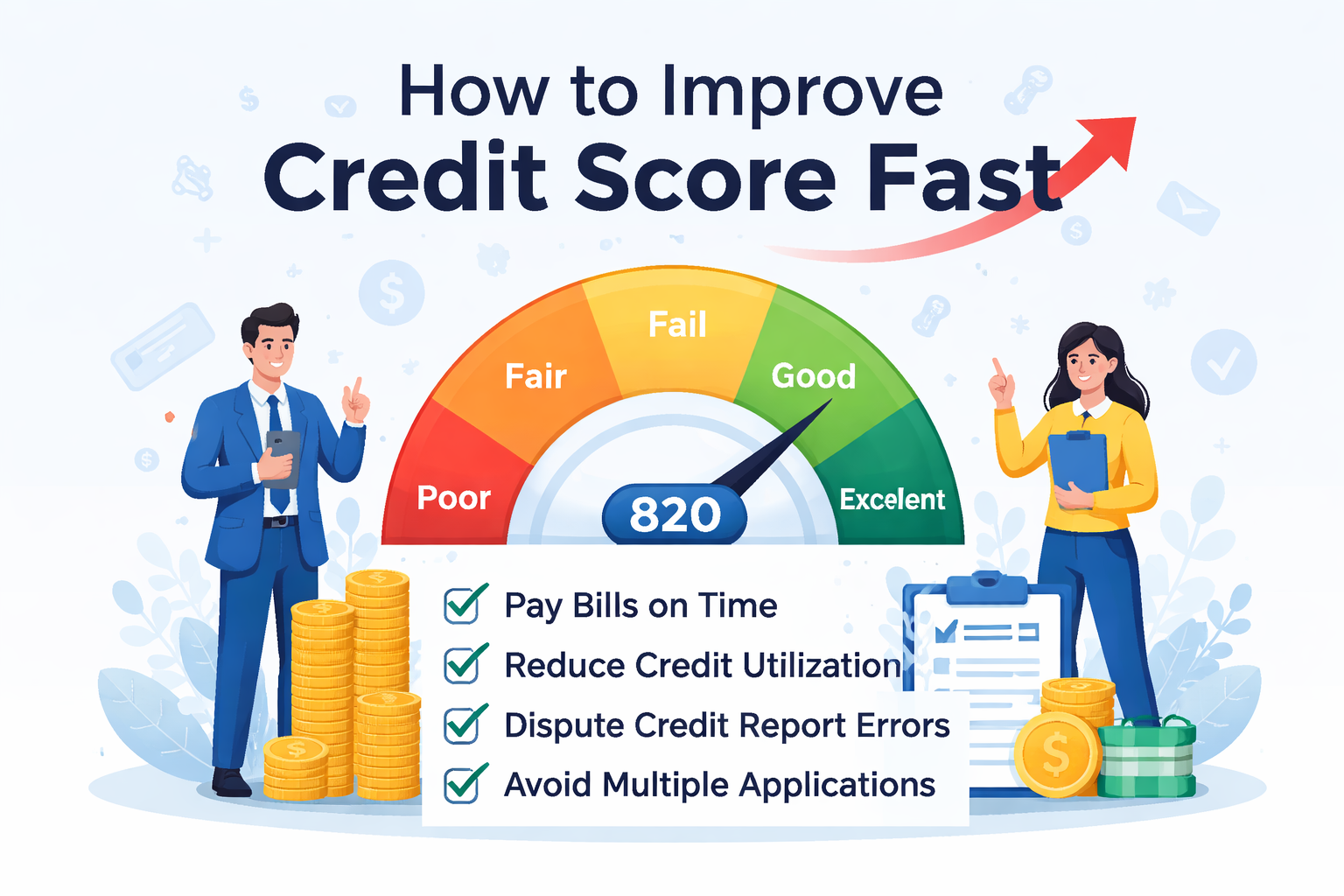
If your loan got rejected or your credit card application was declined, your credit score is likely the reason. A low score can limit your financial freedom, increase your interest rates, and even affect rental approvals.
But here’s the good news: you can improve your credit score fast if you follow the right steps consistently.
In this fully detailed, SEO-optimized guide, you will learn:
- What a credit score is
- Why your credit score is low
- How to improve credit score fast
- Mistakes that destroy your credit score
- Practical step-by-step action plan
- FAQs and expert tips
Let’s begin.
What Is a Credit Score?
A credit score is a 3-digit number that shows how trustworthy you are in repaying borrowed money.
In India, the most widely used score is provided by TransUnion CIBIL and is called the CIBIL Score.
Credit Score Range (India)
- 300–549 – Poor
- 550–649 – Fair
- 650–749 – Good
- 750–900 – Excellent
A score above 750 increases your chances of loan approval and helps you get lower interest rates.
Why Is Your Credit Score Low?
Before learning how to improve credit score fast, you must understand what damages it.
1. Late or Missed EMI Payments
Payment history contributes the largest portion of your credit score. Even one missed EMI can drop your score significantly.
2. High Credit Utilization Ratio
If you are using more than 30–40% of your credit card limit, it negatively impacts your score.
Example:
Credit limit = ₹1,00,000
Spending = ₹80,000
Utilization = 80% (Too high)
3. Too Many Loan Applications
Every time you apply for a loan or credit card, a hard inquiry is recorded. Multiple inquiries reduce your score.
4. Loan Defaults or Settlements
Settling a loan instead of fully repaying it severely impacts your creditworthiness.
5. Errors in Credit Report
Sometimes, incorrect data appears in your report, such as:
- Closed loans showing active
- Wrong outstanding amount
- Duplicate entries

How to Improve Credit Score Fast (Step-by-Step Guide)
Now let’s discuss practical and proven strategies to improve credit score quickly.
1. Pay All EMIs and Credit Card Bills On Time
This is the most powerful factor.
Payment history contributes around 35%–40% of your credit score.
What You Should Do:
- Set automatic payment reminders
- Enable auto-debit facility
- Pay at least minimum due (preferably full amount)
Even 3–6 months of consistent timely payments can significantly improve your score.
2. Reduce Your Credit Utilization Ratio
Credit utilization should ideally stay below 30%.
How to Reduce It Fast:
- Pay off outstanding balances
- Split payments into multiple cycles
- Request higher credit limit (without increasing spending)
If your utilization drops from 80% to 20%, your score can improve quickly within 1–2 months.
3. Don’t Close Old Credit Cards
Length of credit history matters.
Old credit cards show stability and responsible behavior.
If you have a card that is:
- 5–10 years old
- Has good payment history
Keep it active with small transactions.
4. Avoid Multiple Loan Applications
If your loan gets rejected, don’t apply everywhere immediately.
Instead:
- Check your credit report
- Improve your score first
- Wait at least 3–6 months before reapplying
Too many hard inquiries signal financial stress.
5. Check and Correct Errors in Credit Report
Download your credit report from TransUnion CIBIL and review it carefully.
Look for:
- Incorrect late payments
- Loans you never took
- Wrong personal details
File a dispute immediately if you find errors. Correction can boost your score quickly.
6. Pay Off Small Loans First
If you have multiple small loans:
- Close smaller loans first
- Reduce total outstanding liability
- Improve your debt-to-income ratio
This builds positive momentum.
7. Convert Loan Settlements into Full Payments
If you previously “settled” a loan, your report may show “Settled” status.
This negatively impacts your score.
Contact the lender and:
- Pay remaining dues
- Request “Closed” status update
This can significantly improve your credit profile over time.
8. Use a Secured Credit Card
If your score is very low (below 600), apply for a secured credit card against a fixed deposit.
How it works:
- You deposit ₹20,000
- Bank gives card with similar limit
- Use responsibly and pay on time
Within 6–9 months, your score improves steadily.
9. Maintain a Healthy Credit Mix
Credit mix includes:
- Secured loans (home, auto)
- Unsecured loans (personal loan, credit card)
Having a balanced mix improves credibility.
Avoid taking unnecessary loans just to improve mix.
10. Increase Your Income Stability
Lenders consider your financial behavior. Stable income improves your overall creditworthiness.
Ways to improve:
- Avoid job hopping frequently
- Maintain salary account
- Show consistent bank transactions
How Fast Can You Improve Credit Score?
It depends on your situation:
| Situation | Improvement Timeline |
|---|---|
| High utilization | 30–60 days |
| Late payments | 3–6 months |
| Settled loan | 6–12 months |
| Default case | 12–24 months |
Credit improvement is not instant, but consistent actions show results.
Major Mistakes That Destroy Your Credit Score
Avoid these dangerous mistakes:
❌ Missing EMIs
❌ Paying only minimum due every month
❌ Using full credit limit
❌ Taking multiple personal loans
❌ Ignoring credit report errors
❌ Settling loans instead of repaying fully
These habits can drop your score by 50–100 points quickly.
Advanced Tips to Improve Credit Score Faster
Improving your credit score is not only about paying EMIs on time. If you want faster improvement, you need smart financial strategies. These advanced techniques can help you boost your score more efficiently when used correctly.
Let’s understand each point in depth.
1. Pay Before Statement Generation (Smart Timing Strategy)
Most people think paying before the due date is enough. While that prevents late fees, it may not always maximize your credit score improvement.
How Credit Card Reporting Works
When you use a credit card, two important dates matter:
- Statement date – The date when your total outstanding balance is calculated and reported.
- Due date – The last date to pay the bill without penalty.
Credit card companies report your outstanding balance to credit bureaus like TransUnion CIBIL based on the statement balance, not the due date payment.
Why Paying Before Statement Date Helps
If you:
- Spend ₹80,000 on a ₹1,00,000 limit
- Wait for the statement
- Then pay in full before the due date
Your utilization ratio will still show as 80% because that was your statement balance.
But if you:
- Spend ₹80,000
- Pay ₹60,000 before the statement date
- Statement generates with only ₹20,000 balance
Your utilization will show as 20%, which is excellent.
Why This Improves Credit Score Faster
Credit utilization contributes significantly to your score. Lower utilization signals:
- Responsible credit behavior
- Financial discipline
- Lower risk profile
Best Practice
- Keep utilization below 30%
- Ideally below 10% for faster improvement
- Make part-payments before statement generation
This small timing adjustment can improve your score within 30–60 days.
2. Become an Authorized User (Leverage Strong Credit History)
If your credit score is low or you have limited credit history, becoming an authorized user can help.
What Is an Authorized User?
An authorized user is someone added to another person’s credit card account. The primary cardholder remains responsible for payments.
If you are added to a credit card with:
- Long history (5+ years)
- On-time payments
- Low utilization
You may benefit from that positive history.
How It Helps Improve Your Credit Score
When the primary cardholder maintains:
- Excellent payment record
- Low outstanding balance
That account history may reflect on your credit report (depending on issuer policy).
This can:
- Improve your average credit age
- Add positive payment history
- Boost your score faster
Important Precautions
- Choose someone financially disciplined
- Ensure they never miss payments
- Avoid high utilization accounts
If the primary user defaults, your score can also be negatively affected.
Who Should Use This Strategy?
- Young individuals with no credit history
- People rebuilding damaged credit
- Fresh earners starting financial journey
This method works best when combined with your own responsible credit usage.
3. Negotiate With Lenders (Goodwill Adjustment Strategy)
If your credit score dropped due to:
- Temporary job loss
- Medical emergency
- Genuine financial hardship
You may request a goodwill adjustment from your lender.
What Is a Goodwill Adjustment?
A goodwill adjustment is when a lender agrees to remove a late payment mark from your credit report as a gesture of goodwill.
Although not guaranteed, many lenders consider such requests if:
- You have a long history of timely payments
- The late payment was a one-time mistake
- You cleared dues quickly afterward
How to Request It
- Contact customer care
- Explain your situation honestly
- Provide supporting documents (if necessary)
- Request removal of late payment mark
If the lender agrees, they will update the record with bureaus like TransUnion CIBIL.
Why This Can Boost Score Quickly
Payment history is the most influential factor in credit scoring.
Removing even one late payment entry can:
- Increase score significantly
- Improve lender confidence
- Strengthen your credit profile
This strategy works especially well if your score dropped due to a single mistake.
4. Maintain Low Debt-to-Income Ratio (Financial Stability Indicator)
Your Debt-to-Income (DTI) ratio is the percentage of your monthly income used to pay EMIs.
How to Calculate DTI
DTI = (Total Monthly EMIs ÷ Monthly Income) × 100
Example:
- Monthly Income = ₹50,000
- Total EMIs = ₹20,000
DTI = 40%
Why DTI Matters
Although DTI is not directly part of your credit score calculation, lenders consider it during loan approval.
A high DTI indicates:
- Over-dependence on borrowed money
- Higher financial stress
- Increased default risk
A low DTI indicates:
- Financial stability
- Strong repayment capacity
- Responsible borrowing behavior
Ideal DTI Ratio
- Below 30% – Excellent
- 30%–40% – Acceptable
- Above 50% – Risky
How to Reduce DTI
- Avoid unnecessary loans
- Prepay small loans
- Increase income (side income, increments)
- Avoid lifestyle inflation
Lower DTI improves your loan eligibility and strengthens your overall financial profile.
Why These Advanced Strategies Work Faster
Basic credit improvement methods focus on:
- Paying on time
- Reducing utilization
Advanced strategies go deeper by:
- Optimizing reporting timing
- Leveraging positive credit history
- Removing negative marks
- Improving overall financial stability
When combined together, these methods can accelerate credit score improvement significantly.
Credit Score Improvement Action Plan (30–90 Days)
Month 1:
- Check credit report
- Clear overdue payments
- Reduce utilization below 50%
Month 2:
- Bring utilization below 30%
- Avoid new applications
- Pay all bills on time
Month 3:
- Maintain consistency
- Monitor score monthly
- Keep balances low
Consistency is the secret.
Benefits of Having a High Credit Score
- Faster loan approvals
- Lower interest rates
- Higher credit limits
- Pre-approved loan offers
- Better negotiation power
A high credit score saves lakhs of rupees in interest over time.
Frequently Asked Questions (FAQs)
1. How can I improve my credit score fast?
Improving your credit score fast requires focusing on the factors that impact it the most. The first step is to pay all overdue EMIs and credit card bills immediately. Payment history carries the highest weight in your credit score calculation.
Next, reduce your credit utilization ratio below 30%. If your credit card limit is ₹1,00,000, try to keep your outstanding balance below ₹30,000. High utilization signals financial stress and lowers your score.
Avoid applying for multiple loans or credit cards within a short time, as each application results in a hard inquiry. Also, regularly check your credit report from TransUnion CIBIL to correct any errors. With consistent effort, you can see noticeable improvement within 30–90 days.
2. How much time does it take to increase a credit score by 100 points?
The time required depends on the reason your score is low. If your score dropped due to high credit utilization, you may see improvement within 30–60 days after reducing balances.
However, if your score is low because of missed EMIs, loan defaults, or settlements, it may take 6–12 months of consistent on-time payments to gain 100 points.
Credit repair is not instant, but disciplined financial behavior speeds up the recovery process.
3. Does checking my credit score reduce it?
No, checking your own credit score does not reduce it.
When you check your score yourself, it is considered a soft inquiry, which has no impact on your score. However, when a bank checks your credit score for loan approval, it is called a hard inquiry, which may slightly reduce your score.
You can safely check your credit score regularly to monitor progress.
4. What is the fastest way to repair a bad credit score?
The fastest way to repair a bad credit score is:
- Clear all overdue payments immediately.
- Reduce credit card utilization below 30%.
- Avoid new credit applications.
- Correct errors in your credit report.
- Use a secured credit card responsibly if your score is very low.
If you consistently follow these steps for 3–6 months, your credit profile will start improving significantly.
5. Is loan settlement bad for credit score?
Yes, loan settlement is harmful to your credit score.
When you settle a loan, it means you paid less than the total outstanding amount. Your credit report will show the status as “Settled” instead of “Closed.” Lenders consider this risky behavior.
If possible, pay the remaining dues and request the lender to update the status to “Closed.” This improves your long-term creditworthiness.
6. What is a good credit utilization ratio?
A good credit utilization ratio is below 30%.
For example:
- Credit limit = ₹50,000
- Ideal usage = Below ₹15,000
Lower utilization shows responsible credit management. Even if you pay your bills on time, high utilization can reduce your score. Keeping balances low is one of the fastest ways to boost your credit score.
Yes, you can improve your credit score without a credit card.
7. Can I improve my credit score without a credit card?
You can take a small secured loan or use a secured credit card against a fixed deposit. Regularly paying EMIs on time helps build positive payment history.
Even small consumer durable loans, if paid consistently, can help establish and improve your credit profile.
8. How often is the credit score updated?
Credit scores are usually updated monthly when lenders report your payment activity to credit bureaus like TransUnion CIBIL.
If you clear outstanding balances today, it may take 30–45 days to reflect in your updated score. Therefore, patience and consistency are essential.
9. Does paying minimum due help improve credit score?
Paying the minimum due helps you avoid late payment penalties, but it does not significantly improve your credit score.
If you only pay the minimum amount:
- Interest keeps accumulating
- Credit utilization remains high
- Debt burden increases
To improve your score faster, always try to pay the full outstanding amount.
10. What credit score is required for loan approval in India?
Most banks prefer a credit score of 750 or above for easy loan approval. However:
- 700–749: Moderate approval chances
- 650–699: Higher interest rates
- Below 650: Loan rejection likely
Lenders check your score from bureaus like TransUnion CIBIL before approving loans. A higher score gives you better negotiation power and lower interest rates.
Final Thoughts: Discipline Builds Credit Power
Improving your credit score fast is possible, but it requires:
- Discipline
- Consistency
- Smart financial decisions
Avoid shortcuts and focus on building a strong credit history.
If you start today, within 3–6 months you will see noticeable improvement.
Your credit score is your financial reputation. Protect it wisely.
Conclusion: Build a Strong Credit Score, Secure a Strong Financial Future
Improving your credit score fast is absolutely possible — but it requires the right strategy, discipline, and consistency. There are no magic shortcuts, but there are smart financial actions that deliver real results.
If you want faster improvement, focus on the most powerful factors:
- Pay all EMIs and credit card bills on time
- Keep your credit utilization below 30%
- Avoid multiple loan applications
- Check your credit report regularly from TransUnion CIBIL
- Correct errors immediately
- Maintain a low debt-to-income ratio
Even small improvements in your credit habits can lead to significant score growth within 3–6 months.
Remember, your credit score is more than just a number — it is your financial reputation. A high score helps you:
- Get loans approved faster
- Secure lower interest rates
- Receive higher credit limits
- Save thousands (even lakhs) in interest payments
On the other hand, ignoring your credit health can lead to loan rejection, higher borrowing costs, and financial stress.
Start today. Make responsible financial decisions. Stay consistent. Monitor your progress.
With discipline and smart planning, you can transform your credit score — and unlock better financial opportunities for your future.