
Introduction
In today’s digital world, distractions are everywhere. From endless scrolling on social media to binge-watching videos and constant notifications, our brains are overstimulated like never before. This overstimulation is largely driven by a powerful chemical in the brain called dopamine.
If you often feel distracted, unmotivated, or addicted to your phone, it might be time to try a dopamine detox guide. This method helps you reset your brain, regain control over your habits, and improve focus naturally.
In this complete dopamine detox guide, you’ll learn what dopamine is, how overstimulation affects your brain, and step-by-step methods to detox effectively.
What is Dopamine?
Dopamine is a neurotransmitter in your brain responsible for:
- Motivation
- Pleasure
- Reward
- Learning
- Focus
Every time you do something enjoyable—like eating junk food, scrolling social media, or winning a game—your brain releases dopamine.
The Problem
Modern habits trigger excessive dopamine release, including:
- Social media scrolling
- Video games
- Junk food consumption
- Pornography
- Constant entertainment
This leads to dopamine imbalance, making simple tasks like studying or working feel boring.
That’s where a dopamine detox guide becomes essential.
What is a Dopamine Detox?
A dopamine detox guide is a structured approach to reduce overstimulation by temporarily avoiding activities that give instant pleasure.
It doesn’t mean eliminating dopamine (which is impossible). Instead, it means:
👉 Reducing artificial dopamine spikes
👉 Resetting your brain’s reward system
👉 Rebuilding focus and discipline
Benefits of Following a Dopamine Detox Guide
1. Improved Focus
When you follow a dopamine detox guide, your brain becomes less dependent on instant gratification, making it easier to focus on important tasks.
2. Increased Motivation
After detoxing, even small achievements feel rewarding again.
3. Better Mental Health
Reducing overstimulation can lower:
- Anxiety
- Stress
- Mental fatigue
4. Higher Productivity
A proper dopamine detox guide helps you:
- Complete tasks faster
- Avoid procrastination
- Stay consistent
5. Improved Sleep Quality
Less screen time and stimulation improve sleep cycles.
Signs You Need a Dopamine Detox
You may need a dopamine detox guide if you experience:
- Constant phone checking
- Lack of motivation
- Difficulty concentrating
- Addiction to social media
- Procrastination
- Feeling bored easily
- Reduced interest in real-life activities
Science Behind Dopamine Detox
When you overstimulate your brain:
- Dopamine receptors become less sensitive
- You need more stimulation for the same pleasure
- Normal activities feel boring
A dopamine detox guide helps reset this system by:
- Reducing artificial rewards
- Allowing receptors to recover
- Increasing sensitivity to natural rewards
Types of Dopamine Detox
1. Short Detox (24 Hours)
A quick reset using a dopamine detox guide for one day.
2. Weekend Detox
Ideal for beginners who want a manageable approach.
3. Long Detox (7–30 Days)
Best for breaking addictions and building discipline.
Activities to Avoid During Dopamine Detox
A proper dopamine detox guide recommends avoiding:
- Social media
- Video games
- Netflix/YouTube binge
- Junk food
- Pornography
- Excessive music
- Mindless browsing
Healthy Activities During Detox
When you follow a dopamine detox guide, the goal is not just to remove unhealthy habits but to replace them with meaningful and fulfilling activities. This is the most important part of a successful detox. If you only remove distractions without adding positive alternatives, you may feel bored and eventually fall back into old habits.
Below are the most effective and healthy activities you should include in your dopamine detox guide, explained in full detail so you can easily apply them in your daily life.
1. Reading Books
Reading is one of the best activities you can include in your dopamine detox guide because it provides slow, meaningful stimulation instead of instant gratification.
Why Reading Works
Unlike social media, reading:
- Requires focus and attention
- Improves imagination
- Builds knowledge gradually
- Strengthens your brain’s ability to concentrate
When you read regularly, your brain starts enjoying deep focus again, which is often lost due to digital distractions.
What to Read
Choose books that align with your goals:
- Self-improvement books
- Educational or academic material
- Biographies
- Fiction for relaxation
How to Start
- Begin with 10–15 minutes daily
- Keep a book near your bed or workspace
- Replace phone scrolling with reading
Pro Tip
During your dopamine detox guide, try reading in the morning instead of checking your phone. This sets a productive tone for the entire day.
2. Exercise
Exercise is a powerful and natural way to regulate dopamine levels, making it a key part of any dopamine detox guide.
Why Exercise is Important
Physical activity:
- Releases healthy dopamine
- Reduces stress and anxiety
- Improves mood
- Boosts energy levels
Unlike artificial dopamine spikes, exercise provides long-lasting satisfaction.
Types of Exercise
You don’t need a gym. Simple activities include:
- Walking
- Running
- Yoga
- Home workouts
- Strength training
How to Include Exercise
- Start with 20–30 minutes daily
- Choose a time you enjoy (morning or evening)
- Stay consistent rather than intense
Pro Tip
During your dopamine detox guide, avoid overcomplicating your routine. Even a simple walk can have powerful effects.
3. Meditation
Meditation is one of the most effective tools to reset your brain and is highly recommended in every dopamine detox guide.
Why Meditation Helps
Meditation:
- Calms the mind
- Improves focus
- Reduces impulsive behavior
- Increases awareness of habits
It trains your brain to be comfortable without constant stimulation.
How to Practice
- Sit quietly for 5–10 minutes
- Focus on your breathing
- Observe your thoughts without reacting
Types of Meditation
- Mindfulness meditation
- Deep breathing
- Body scan meditation
Pro Tip
Consistency matters more than duration. Even 5 minutes daily can make a big difference in your dopamine detox guide journey.
4. Journaling
Journaling is a simple but powerful activity to include in your dopamine detox guide. It helps you understand your thoughts, habits, and emotions.
Benefits of Journaling
- Clears mental clutter
- Improves self-awareness
- Tracks progress
- Reduces stress
When you write regularly, you become more conscious of your behaviors, which helps you control dopamine-driven habits.
What to Write
You can journal about:
- Daily activities
- Goals
- Feelings
- Gratitude
- Progress in your detox
How to Start
- Write for 5–10 minutes daily
- Don’t worry about grammar or structure
- Be honest with yourself
Pro Tip
Use journaling to track your progress in your dopamine detox guide. This helps you stay motivated and consistent.
5. Walking in Nature
Spending time in nature is one of the most underrated yet powerful parts of a dopamine detox guide.
Why Nature Helps
Nature provides:
- Calm and relaxation
- Reduced stress levels
- Improved mental clarity
- Natural dopamine balance
It helps your brain disconnect from artificial stimulation and reconnect with real life.
How to Practice
- Take a 20–30 minute walk daily
- Visit parks or green areas
- Avoid using your phone during the walk
What to Focus On
- Sounds of nature
- Fresh air
- Your breathing
- Surroundings
Pro Tip
Combine walking with mindfulness to enhance the benefits of your dopamine detox guide.
6. Deep Work / Studying
Deep work is the ability to focus on a task without distraction, and it is one of the main goals of a dopamine detox guide.
Why Deep Work Matters
In today’s world, most people struggle with focus. Deep work helps you:
- Complete tasks faster
- Improve learning ability
- Increase productivity
- Build discipline
How to Practice Deep Work
- Choose one task at a time
- Remove all distractions
- Set a timer (25–60 minutes)
- Take short breaks between sessions
Techniques to Use
- Pomodoro Technique
- Time blocking
- Task prioritization
Pro Tip
Start with short sessions and gradually increase. Deep work becomes easier as you progress in your dopamine detox guide.
Step-by-Step Dopamine Detox Guide
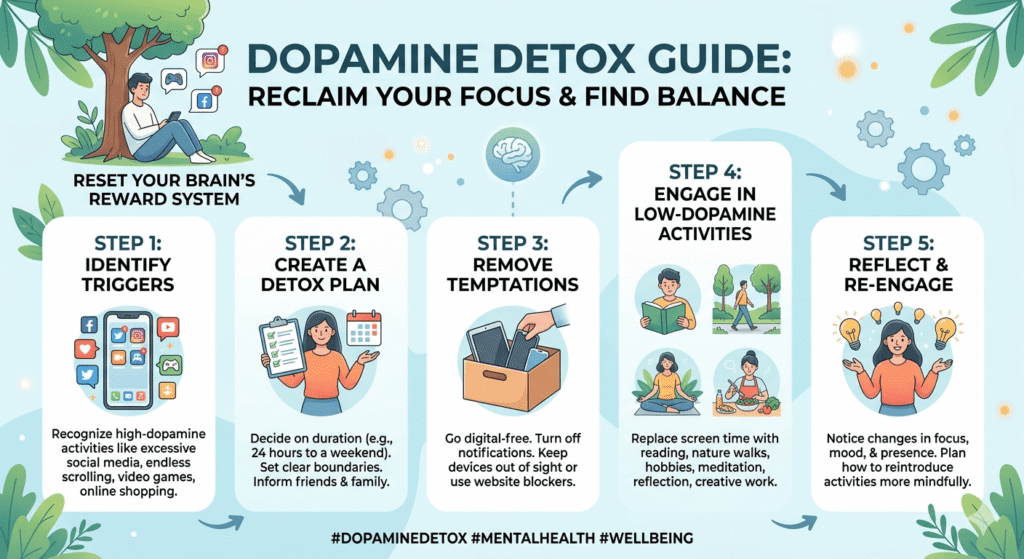
Step 1: Set Clear Goals
Ask yourself:
- Why do I need a dopamine detox guide?
- What habits do I want to fix?
Write your goals clearly.
Step 2: Identify Your Triggers
Common triggers include:
- Phone notifications
- Boredom
- Stress
Understanding triggers is key in a dopamine detox guide.
Step 3: Start Small
Don’t go extreme immediately.
Example:
- Day 1: No social media for 2 hours
- Day 2: Increase to 4 hours
Step 4: Remove Distractions
- Turn off notifications
- Use app blockers
- Keep phone away
This step is crucial in any dopamine detox guide.
Step 5: Replace Bad Habits
Instead of scrolling:
- Read a book
- Exercise
- Learn a skill
Step 6: Practice Mindfulness
Meditation helps reset dopamine levels.
Even 10 minutes daily works in a dopamine detox guide.
Step 7: Track Your Progress
Use a journal to monitor:
- Screen time
- Productivity
- Mood
7-Day Dopamine Detox Plan
Day 1–2
- Reduce social media
- Avoid junk food
Day 3–4
- No entertainment apps
- Focus on productive tasks
Day 5–6
- Limit phone usage
- Add meditation
Day 7
- Full detox day
- No digital distractions
This structured dopamine detox guide helps beginners succeed.
Common Mistakes to Avoid in a Dopamine Detox Guide
Following a dopamine detox guide can be life-changing, but many people fail to see results because they make simple yet critical mistakes. Understanding these mistakes in advance will help you stay consistent, avoid frustration, and get the maximum benefits from your detox journey.
Let’s explore the most common mistakes in a dopamine detox guide in full detail and learn how to avoid them.
1. Going Too Extreme
One of the biggest mistakes people make when starting a dopamine detox guide is trying to eliminate all sources of pleasure at once.
Why This Happens
When people feel overwhelmed or frustrated with their habits, they often decide to:
- Quit social media completely overnight
- Stop watching any entertainment
- Avoid all forms of relaxation
- Follow a very strict routine
While this sounds disciplined, it is often unsustainable.
Why It’s a Problem
Going too extreme can lead to:
- Mental exhaustion
- Frustration
- Loss of motivation
- Burnout
- Giving up completely
Your brain is used to high levels of stimulation. Suddenly removing everything creates a shock, making the dopamine detox guide feel painful instead of helpful.
What You Should Do Instead
A successful dopamine detox guide should be gradual:
- Start by reducing screen time step by step
- Limit, not eliminate, enjoyable activities
- Focus on consistency rather than perfection
Example
Instead of:
👉 “I will not use my phone at all”
Do this:
👉 “I will reduce my screen time by 2 hours daily”
Key Takeaway
Balance is the key. A sustainable dopamine detox guide always focuses on progress, not extremes.
2. Not Replacing Habits
Another major mistake in a dopamine detox guide is removing bad habits without replacing them with positive ones.
Why This Happens
People think detox means:
- Just quitting social media
- Avoiding entertainment
- Removing distractions
But they don’t plan what to do instead.
Why It’s a Problem
When you remove habits without replacement:
- You feel bored
- Your brain looks for quick stimulation again
- You return to old habits
This creates a cycle of failure in your dopamine detox guide.
The Science Behind It
Your brain is wired to seek rewards. If you remove one source of dopamine, it will automatically search for another.
Without healthy alternatives, you’ll go back to:
- Scrolling
- Watching videos
- Other addictive behaviors
What You Should Do Instead
Always replace bad habits with good ones:
- Replace scrolling → Reading
- Replace gaming → Exercise
- Replace binge-watching → Learning a skill
Example
Instead of:
👉 Removing Instagram and doing nothing
Do this:
👉 Replace Instagram time with journaling or walking
Key Takeaway
A successful dopamine detox guide is not about removing habits—it’s about replacing them with better ones.
3. Expecting Instant Results
Many people expect immediate changes when following a dopamine detox guide, and when they don’t see quick results, they feel discouraged.
Why This Happens
We live in a world of instant gratification:
- Quick entertainment
- Fast results
- Immediate rewards
So naturally, people expect the same from a dopamine detox guide.
Why It’s a Problem
Unrealistic expectations can lead to:
- Frustration
- Self-doubt
- Lack of motivation
- Quitting early
The Reality
Your brain needs time to reset. Dopamine levels and habits built over months or years cannot change overnight.
What You Should Expect
During the first few days of a dopamine detox guide, you may feel:
- Bored
- Restless
- Uncomfortable
- Less motivated
This is completely normal.
When Results Appear
With consistency, you’ll start noticing:
- Better focus (after 5–7 days)
- Increased motivation (after 1–2 weeks)
- Improved mental clarity (after a few weeks)
What You Should Do Instead
- Be patient with yourself
- Focus on small improvements
- Celebrate small wins
Example
Instead of:
👉 “Why am I not focused after 2 days?”
Think:
👉 “I’m improving slowly, and that’s progress”
Key Takeaway
A dopamine detox guide is a long-term process. Consistency beats speed.
4. Ignoring Mental Health
Many people focus only on productivity while following a dopamine detox guide and ignore their mental and emotional well-being.
Why This Happens
Some believe detox means:
- Constant discipline
- No relaxation
- No enjoyment
- Only work and productivity
This mindset can be harmful.
Why It’s a Problem
Ignoring mental health can lead to:
- Stress
- Anxiety
- Emotional burnout
- Negative thinking
A dopamine detox guide should improve your life, not make it harder.
The Right Approach
Balance is essential. Your detox should include:
- Productive activities
- Relaxation
- Self-care
Healthy Balance Includes
- Taking breaks
- Spending time with loved ones
- Enjoying simple pleasures
- Practicing mindfulness
Example
Instead of:
👉 Working all day without breaks
Do this:
👉 Work in focused sessions with rest periods
Pro Tip
Your dopamine detox guide should feel calm and controlled, not stressful.
Dopamine Detox for Students
Students benefit greatly from a dopamine detox guide:
- Better concentration
- Improved study habits
- Reduced distractions
Tips:
- Study in a quiet place
- Avoid phone during study
- Use Pomodoro technique
Dopamine Detox for Professionals
For working individuals, a dopamine detox guide helps:
- Increase productivity
- Reduce burnout
- Improve decision-making
Dopamine Detox and Social Media
Social media is the biggest dopamine trigger.
A dopamine detox guide suggests:
- Uninstall apps temporarily
- Use time limits
- Avoid mindless scrolling
Dopamine Detox and Mental Health
A proper dopamine detox guide can help:
- Reduce anxiety
- Improve mood
- Increase emotional stability
Long-Term Benefits of Dopamine Detox
Following a dopamine detox guide regularly leads to:
- Strong discipline
- Better habits
- Increased focus
- Higher life satisfaction
Tools to Help Dopamine Detox
Helpful tools:
- App blockers
- Screen time trackers
- Journaling apps
These support your dopamine detox guide journey.
Sample Daily Routine
Morning:
- No phone for 1 hour
- Exercise
- Meditation
Afternoon:
- Deep work
- Healthy meals
Evening:
- Reading
- Reflection
This routine complements a dopamine detox guide perfectly.
10 FAQs on Dopamine Detox Guide
Here are the most commonly asked questions about a dopamine detox guide, explained in a simple and user-friendly way to help you understand and apply it effectively.
1. What is a dopamine detox guide?
A dopamine detox guide is a structured method to reduce overstimulation from activities like social media, junk food, and constant entertainment. It helps reset your brain’s reward system so you can regain focus, motivation, and control over your habits.
2. Does a dopamine detox mean removing dopamine completely?
No, a dopamine detox guide does not mean eliminating dopamine. Dopamine is essential for survival and normal brain function. The goal is to reduce artificial dopamine spikes and allow your brain to respond better to natural rewards.
3. How long should I follow a dopamine detox guide?
The duration depends on your goals:
- Beginners: 24 hours to 3 days
- Intermediate: 7 days
- Advanced: 14–30 days
You can also follow a dopamine detox guide regularly, such as once a week or once a month, for maintenance.
4. Can I use my phone during a dopamine detox?
Yes, but in a controlled way. A balanced dopamine detox guide allows essential phone use like:
- Work-related tasks
- Important calls
- Necessary communication
However, avoid mindless scrolling, gaming, and excessive social media.
5. Will I feel bored during a dopamine detox?
Yes, especially in the beginning. When you follow a dopamine detox guide, your brain is adjusting to lower stimulation levels. Boredom is a natural part of the process and usually fades within a few days.
6. Is a dopamine detox scientifically proven?
The concept of a dopamine detox guide is based on behavioral science and habit formation. While the term itself is popularized online, the principles—reducing overstimulation and improving focus—are supported by neuroscience.
7. Can a dopamine detox help with addiction?
A dopamine detox guide can help reduce addictive behaviors by breaking the cycle of instant gratification. While it may not fully cure severe addiction, it is a powerful tool for improving self-control and awareness.
8. What activities are allowed during a dopamine detox?
A proper dopamine detox guide encourages healthy and meaningful activities like:
- Reading
- Exercise
- Meditation
- Journaling
- Studying
- Walking in nature
These activities provide natural and balanced dopamine release.
9. How often should I do a dopamine detox?
You can follow a dopamine detox guide:
- Weekly (1 day detox)
- Monthly (weekend detox)
- Occasionally (when feeling overwhelmed or distracted)
Consistency is more important than frequency.
10. What results can I expect from a dopamine detox?
If you follow a dopamine detox guide consistently, you may experience:
- Improved focus
- Better self-discipline
- Increased motivation
- Reduced screen addiction
- Enhanced mental clarity
Results may take time, but they are long-lasting.
Final Thoughts and Conclusion
A dopamine detox guide is not about living a boring or restricted life—it’s about retraining your brain to enjoy the right things. In today’s fast-paced digital world, where instant gratification is everywhere, losing control over your attention has become very common. This is exactly why following a structured dopamine detox guide can be so powerful.
By reducing overstimulation and replacing unhealthy habits with meaningful activities, you begin to take back control of your time, focus, and energy. Simple things like reading, exercising, or even sitting quietly start to feel rewarding again. This is the true purpose of a dopamine detox guide—to help you reconnect with real, lasting satisfaction instead of temporary pleasure.
It’s important to remember that this is not a quick fix. A dopamine detox guide works best when practiced consistently and patiently. You may feel bored or uncomfortable at the beginning, but that is a natural part of the process. Over time, your brain adapts, your focus improves, and your motivation returns stronger than before.
Also, balance is key. A successful dopamine detox guide does not mean removing all enjoyment from your life. Instead, it teaches you to control your habits rather than letting your habits control you. Small, sustainable changes will always be more effective than extreme restrictions.
In the long run, following a dopamine detox guide can lead to:
- Better focus and productivity
- Stronger self-discipline
- Improved mental clarity
- Healthier habits
- Greater life satisfaction
Start small, stay consistent, and trust the process. Even a few positive changes can create a big impact over time.
👉 In the end, a dopamine detox guide is not just about detoxing your brain—it’s about building a better, more focused, and more intentional life.