Introduction
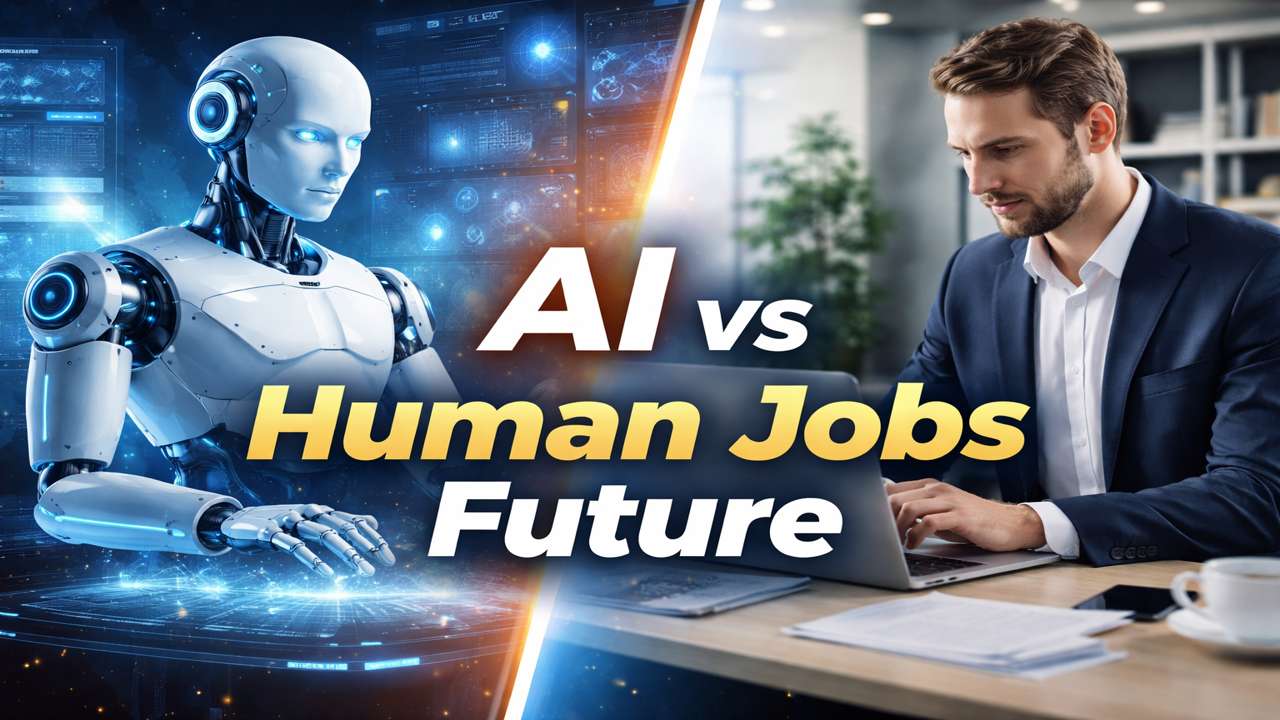
The debate around AI vs human jobs future is one of the most important discussions of our time. As artificial intelligence continues to evolve rapidly, many people are asking: Will AI replace human jobs? Or will it create new opportunities? From automation in factories to smart chatbots in customer service, AI is transforming industries at an unprecedented speed.
Technologies like ChatGPT, Google Gemini, and IBM Watson are reshaping how businesses operate. Meanwhile, innovators like Elon Musk and Sam Altman frequently discuss the impact of AI on employment and society.
In this comprehensive guide, we will explore the AI vs human jobs future in detail. You will learn about industries most affected by AI, jobs that are safe, new careers emerging due to AI, skills you need to survive, and how to prepare for the next decade.
1. Understanding Artificial Intelligence
Before diving into the AI vs human jobs future, let’s understand what AI really means.
Artificial Intelligence refers to machines or systems designed to mimic human intelligence. These systems can:
- Learn from data
- Recognize patterns
- Make decisions
- Solve problems
- Understand language
- Generate content
AI includes:
- Machine Learning
- Deep Learning
- Natural Language Processing
- Robotics
- Computer Vision
Unlike traditional software, AI can improve over time without direct programming changes.
2. The Rise of Automation
Automation is not new. During the Industrial Revolution, machines replaced many manual jobs. But the current wave is different.
Today’s automation is powered by AI. It doesn’t just replace physical labor; it also replaces cognitive tasks.
In the AI vs human jobs future, automation is expected to:
- Reduce repetitive jobs
- Improve efficiency
- Lower operational costs
- Increase productivity
However, automation also raises concerns about job displacement.
3. Industries Most Affected by AI
The AI vs human jobs future varies across industries. Some sectors are more vulnerable than others.
3.1 Manufacturing
Robots already assemble cars and electronics. AI-powered robots work 24/7 without fatigue. Many assembly-line jobs may decline, but new roles in robotics maintenance will increase.
3.2 Customer Service
AI chatbots handle queries instantly. Virtual assistants reduce the need for large call centers. However, complex problem-solving still requires humans.
3.3 Healthcare
AI can analyze medical images faster than doctors. It assists in diagnosis, drug discovery, and patient monitoring. But empathy and human interaction remain essential in healthcare.
3.4 Finance
AI automates:
- Fraud detection
- Risk assessment
- Algorithmic trading
- Loan approvals
While clerical roles may decrease, AI specialists and data analysts are in high demand.
3.5 Education
AI tutors provide personalized learning experiences. Yet, teachers remain irreplaceable in mentoring and emotional guidance.
4. Jobs Most at Risk
In the AI vs human jobs future, the following jobs face higher risk:
- Data entry clerks
- Telemarketers
- Cashiers
- Assembly line workers
- Basic accounting roles
- Travel agents
These roles involve repetitive and rule-based tasks, which AI can automate efficiently.
5. Jobs That Are Safe from AI
Not all jobs are threatened. The AI vs human jobs future also highlights secure career paths.
5.1 Creative Professionals
Writers, designers, and artists rely on creativity. While AI assists, original thinking still matters.
5.2 Healthcare Workers
Nurses, therapists, and caregivers require empathy and human connection.
5.3 Skilled Trades
Electricians, plumbers, and mechanics perform physical, hands-on tasks that are difficult to automate.
5.4 Leadership Roles
CEOs and managers make complex strategic decisions.
6. New Jobs Created by AI
The AI vs human jobs future is not only about job loss. AI is also creating new opportunities.
- AI Engineer
- Machine Learning Specialist
- Data Scientist
- AI Ethics Consultant
- Prompt Engineer
- Robotics Technician
- AI Product Manager
Technology always creates new roles while eliminating old ones.
7. Human Strengths vs AI Strengths
AI Strengths
- Speed
- Accuracy
- Data processing
- Consistency
- 24/7 availability
Human Strengths
- Creativity
- Emotional intelligence
- Critical thinking
- Moral judgment
- Adaptability
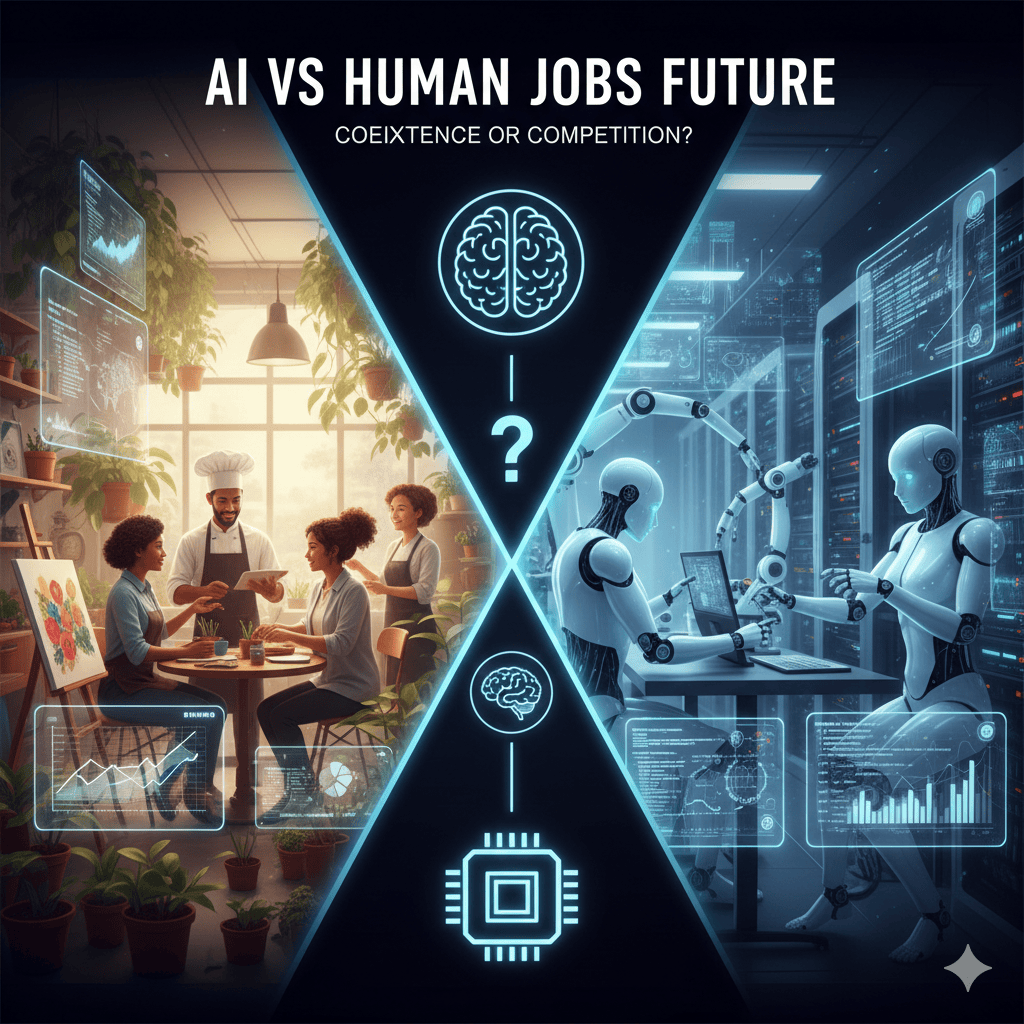
The AI vs human jobs future will likely focus on collaboration rather than competition.
8. AI and Job Transformation
Instead of replacing humans completely, AI is transforming jobs.
For example:
- Doctors use AI tools for diagnosis.
- Writers use AI for research and drafting.
- Marketers use AI for customer analytics.
This hybrid approach defines the modern AI vs human jobs future.
9. Will AI Cause Mass Unemployment?
This is a major concern in the AI vs human jobs future debate.
Some economists believe:
- Short-term disruption will happen.
- Long-term job creation will balance losses.
Historically, technological revolutions created more jobs than they destroyed.
10. Skills Needed for the Future
To survive in the AI vs human jobs future, you must upgrade your skills.
10.1 Technical Skills
- Data analysis
- Coding
- AI tools knowledge
- Cybersecurity
10.2 Soft Skills
- Communication
- Emotional intelligence
- Leadership
- Creativity
10.3 Adaptability
Continuous learning is key.
11. Education System and AI
Education must adapt to the AI vs human jobs future.
Schools should:
- Teach digital literacy
- Focus on critical thinking
- Encourage innovation
- Promote lifelong learning
Traditional rote learning will become outdated.
12. Ethical Concerns in AI Employment
The AI vs human jobs future also raises ethical issues:
- Bias in AI algorithms
- Privacy concerns
- Wage inequality
- Corporate power concentration
Governments must regulate AI responsibly.
13. AI in Developing Countries
In developing nations, automation may affect low-skilled workers significantly.
However:
- Remote AI-based jobs can create opportunities
- Digital entrepreneurship can grow
- Online freelancing may expand
The AI vs human jobs future is global.
14. Remote Work and AI
AI enables remote work by:
- Automating scheduling
- Improving communication
- Enhancing collaboration
Remote jobs are expected to increase in the AI vs human jobs future.
15. AI Collaboration: The Real Future
The realistic outcome of the AI vs human jobs future is collaboration.
AI + Human = Higher productivity
Instead of competition, partnership will dominate the future workplace.
16. Government Policies and AI
Governments must:
- Invest in reskilling programs
- Support AI innovation
- Protect displaced workers
- Encourage ethical AI
Public policy will shape the AI vs human jobs future.
17. Future Predictions (2026–2035)
Experts predict:
- 40–50% of routine jobs may be automated
- AI-driven startups will increase
- Hybrid roles will dominate
- Lifelong learning will become mandatory
The AI vs human jobs future will be dynamic and evolving.
18. How to Prepare for AI-Dominated Future
- Learn AI basics
- Upgrade digital skills
- Develop creativity
- Build personal brand
- Network globally
- Stay adaptable
Preparation is the key to winning in the AI vs human jobs future.
19. Myths About AI and Jobs
Myth 1: AI Will Replace All Jobs
Reality: AI will transform jobs.
Myth 2: Only Tech Workers Are Safe
Reality: Soft skills matter everywhere.
Myth 3: AI Has No Limits
Reality: AI lacks human emotion and ethics.
Understanding these myths clarifies the AI vs human jobs future.
10 High-Ranking FAQs
1. Will AI replace human jobs completely in the future?
No, AI is unlikely to replace all human jobs. While automation will reduce repetitive and routine roles, many jobs require creativity, emotional intelligence, and critical thinking—skills that AI cannot fully replicate. The AI vs human jobs future is more about collaboration than complete replacement.
2. Which jobs are most at risk due to AI?
Jobs that involve repetitive, rule-based tasks are at higher risk. Examples include data entry clerks, telemarketers, cashiers, basic accounting roles, and assembly line workers. In the AI vs human jobs future, automation will primarily impact predictable and structured tasks.
3. What jobs are safe from AI automation?
Jobs that require creativity, empathy, leadership, and hands-on skills are safer. These include healthcare professionals, teachers, therapists, skilled trades workers, and creative professionals. The AI vs human jobs future still strongly values human-centered roles.
4. Will AI create new job opportunities?
Yes, AI is creating new career paths such as AI engineers, machine learning specialists, data scientists, robotics technicians, and AI ethics consultants. The AI vs human jobs future will bring both job displacement and job creation.
5. How can workers prepare for the AI-driven job market?
Workers should focus on upgrading digital skills, learning basic AI tools, improving soft skills like communication and adaptability, and committing to lifelong learning. Success in the AI vs human jobs future depends on continuous skill development.
6. Is AI a threat to freshers and entry-level employees?
AI may reduce some entry-level roles that involve routine tasks. However, freshers who learn AI tools, digital skills, and problem-solving abilities can gain a competitive advantage in the evolving AI vs human jobs future.
7. Will AI increase unemployment rates?
In the short term, AI may disrupt certain industries. However, history shows that technological revolutions eventually create new industries and opportunities. The long-term AI vs human jobs future is expected to balance job losses with new employment growth.
8. Can AI outperform humans in decision-making?
AI can analyze massive amounts of data quickly and accurately, making it powerful for data-driven decisions. However, AI lacks moral judgment, intuition, and emotional understanding. In the AI vs human jobs future, strategic decisions will likely involve both AI insights and human oversight.
9. How will AI impact developing countries?
AI may challenge low-skilled labor markets in developing countries. However, it also opens global remote job opportunities, digital entrepreneurship, and tech-based careers. The AI vs human jobs future can create growth if proper education and digital infrastructure are available.
10. What is the long-term outlook of AI vs human jobs future?
The long-term outlook suggests a hybrid work model where humans and AI collaborate. AI will handle repetitive tasks, while humans focus on innovation, creativity, and leadership. The AI vs human jobs future will reward adaptability and continuous learning.
Final Thought
The conversation around AI vs human jobs future often creates fear, but the real story is about evolution, not elimination. Every generation faces a major shift in how work is done. This time, that shift is powered by artificial intelligence. The difference is not whether AI will exist in the workplace—it already does. The real difference will be how we respond to it.
In the coming years, the AI vs human jobs future will reward those who stay curious, flexible, and willing to learn. Technology will continue to advance, but human qualities like creativity, empathy, leadership, and ethical judgment will remain irreplaceable. AI may analyze data faster than any person, but it cannot dream, inspire, or build meaningful human relationships.
Rather than competing with machines, the smarter strategy is to collaborate with them. Learn how AI tools work. Use them to increase your productivity. Combine technical knowledge with strong communication and problem-solving skills. That combination will define success in the AI vs human jobs future.
The future of work will not belong to AI alone.
It will belong to people who adapt faster than change itself.
Final Conclusion: The Real Truth About AI vs Human Jobs Future
The debate around AI vs human jobs future is not a simple battle between machines and people. It is a transformation of how work is done, how industries operate, and how individuals build careers. Artificial intelligence is not just another technological upgrade—it is a structural shift that is redefining productivity, skills, and opportunity across the globe.
Over the past few decades, every major technological revolution has sparked fear. From the Industrial Revolution to the rise of computers and the internet, people worried about job losses. Yet history shows that innovation destroys some roles while creating many new ones. The same pattern is emerging in the AI vs human jobs future.
AI Is Changing Work, Not Ending It
AI is exceptionally powerful at handling repetitive, predictable, and data-heavy tasks. It can process millions of data points in seconds, automate workflows, and reduce human error. In industries like manufacturing, finance, and customer service, AI-driven systems are already improving efficiency and lowering costs.
However, AI lacks emotional intelligence, moral reasoning, creativity, and genuine human connection. These human qualities remain essential in leadership, healthcare, education, counseling, entrepreneurship, and creative industries. This balance is the core of the AI vs human jobs future—AI handles automation, while humans focus on innovation and empathy.
The Rise of Human-AI Collaboration
The future will not be “AI vs humans.” It will be “AI with humans.”
Doctors use AI to detect diseases earlier. Marketers use AI to analyze customer behavior. Writers use AI tools for research and idea generation. Engineers use AI simulations to design smarter products. In each case, AI enhances human capability rather than eliminating it.
This collaboration model will define the next decade. Workers who learn how to use AI tools effectively will outperform those who ignore them. In the AI vs human jobs future, the most successful professionals will be those who combine technical literacy with human-centered skills.
The Skills That Will Matter Most
To thrive in the evolving workplace, individuals must shift their focus. The most valuable skills in the AI vs human jobs future include:
- Critical thinking
- Creativity
- Emotional intelligence
- Adaptability
- Problem-solving
- Digital literacy
- Communication
- Leadership
Technical knowledge of AI tools is important, but soft skills will become even more powerful differentiators. Machines can analyze data, but they cannot build trust, inspire teams, or understand complex human emotions.
Opportunities for the Younger Generation
For students and freshers, the AI vs human jobs future presents both challenges and opportunities. Entry-level roles involving repetitive tasks may decline, but entirely new career paths are emerging—AI engineering, data science, prompt engineering, robotics maintenance, AI ethics consulting, and more.
Young professionals who invest in continuous learning will gain a significant advantage. Online courses, certifications, internships, and practical projects can help build future-ready skills. The key is not to fear AI but to understand and leverage it.
The Role of Governments and Organizations
Governments and companies also play a critical role in shaping the AI vs human jobs future. Policies that support reskilling programs, digital education, and ethical AI development will determine whether societies thrive or struggle.
Organizations must prioritize employee training and responsible AI integration. Ethical frameworks are essential to prevent bias, protect privacy, and ensure fair opportunities for workers.
The Bigger Picture
The AI vs human jobs future is not just about employment—it is about economic transformation. AI can increase productivity, reduce costs, accelerate innovation, and create entirely new industries. At the same time, it requires societies to rethink education systems, workforce planning, and social safety nets.
Change is inevitable. Resistance to change can lead to fear and stagnation. Adaptation leads to growth and opportunity.
The Powerful Reality
The ultimate truth about the AI vs human jobs future is this:
AI will not replace humans.
Humans who know how to use AI will replace those who don’t.
This statement captures the essence of the coming decade. The future belongs to adaptable learners, creative thinkers, and emotionally intelligent leaders. It belongs to people who are willing to evolve alongside technology.
Instead of asking whether AI will take jobs, the better question is:
How can we use AI to create better jobs, smarter businesses, and a more innovative world?
The AI vs human jobs future is not a threat—it is an opportunity. Those who prepare, learn continuously, and embrace collaboration with intelligent machines will not just survive—they will lead.
The future of work is not man versus machine.
It is man empowered by machine.