Introduction
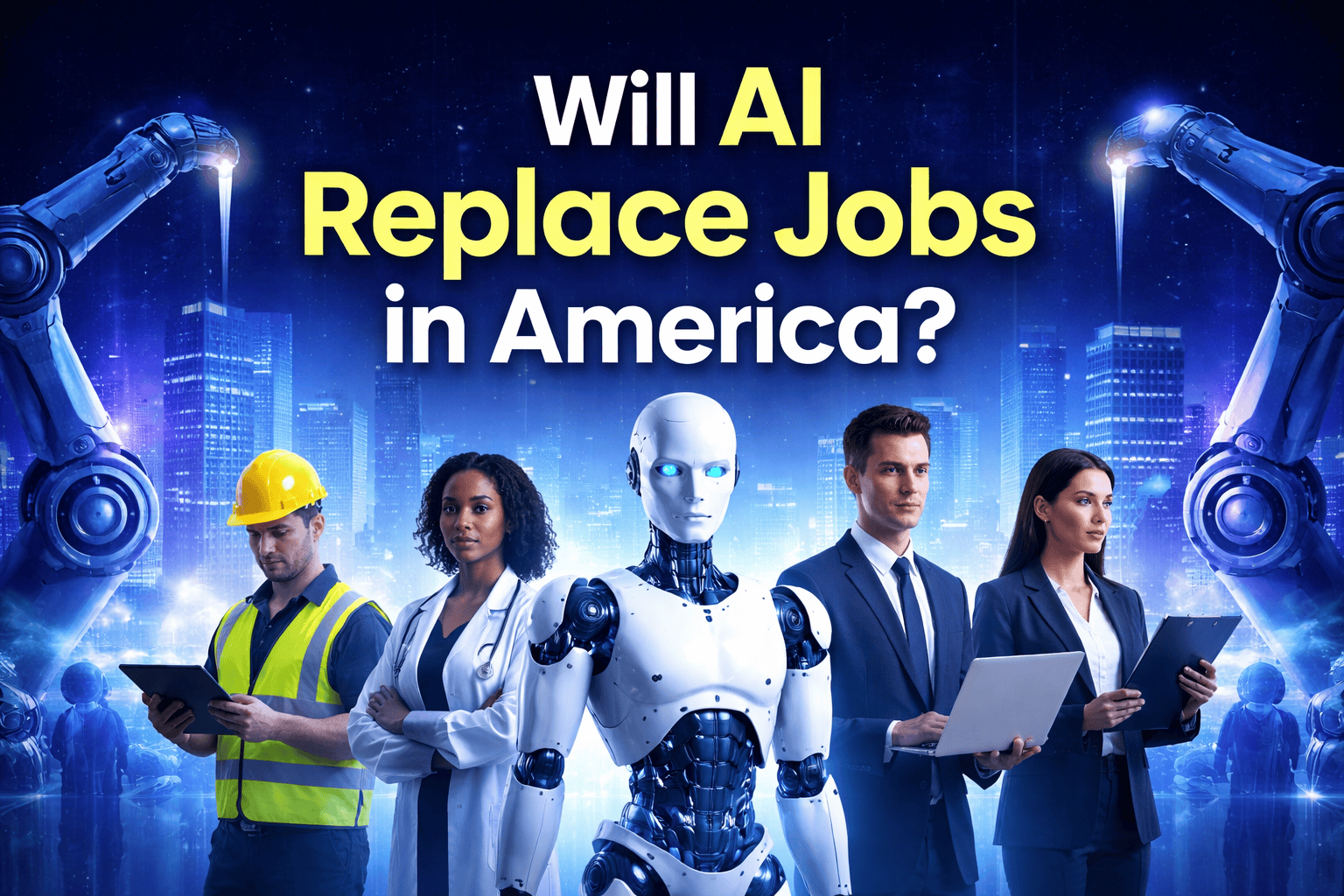
Artificial Intelligence (AI) is no longer a futuristic concept—it is already transforming industries across the United States. From self-checkout machines in retail stores to advanced algorithms in healthcare and finance, AI is reshaping how businesses operate. This rapid evolution has sparked one major question in the minds of millions:
👉 Will AI replace jobs in America?
This question is not just about technology—it’s about the future of work, income stability, and economic growth. While some fear widespread unemployment, others believe AI will create new opportunities.
In this detailed guide, we will explore the real impact of AI on jobs in America, industries at risk, jobs that are safe, and how you can prepare for the future.
What is Artificial Intelligence?
Artificial Intelligence refers to machines or systems that can perform tasks that typically require human intelligence.
Key Capabilities of AI
- Learning from data (Machine Learning)
- Understanding language (Natural Language Processing)
- Recognizing patterns and images
- Automating repetitive tasks
- Making decisions based on algorithms
AI is used in:
- Healthcare
- Finance
- Manufacturing
- Retail
- Transportation
Understanding AI is crucial to answering the question: Will AI replace jobs in America?
The Current State of AI in America
AI adoption in the U.S. is growing rapidly.
Key Trends
- Businesses are investing billions in AI technologies
- Automation is increasing in factories and offices
- AI tools like chatbots and virtual assistants are common
- Remote work and digital transformation are accelerating AI use
Industries Leading AI Adoption
- Technology companies
- Financial services
- Healthcare systems
- E-commerce platforms
These developments are fueling the debate: Will AI replace jobs in America or transform them?
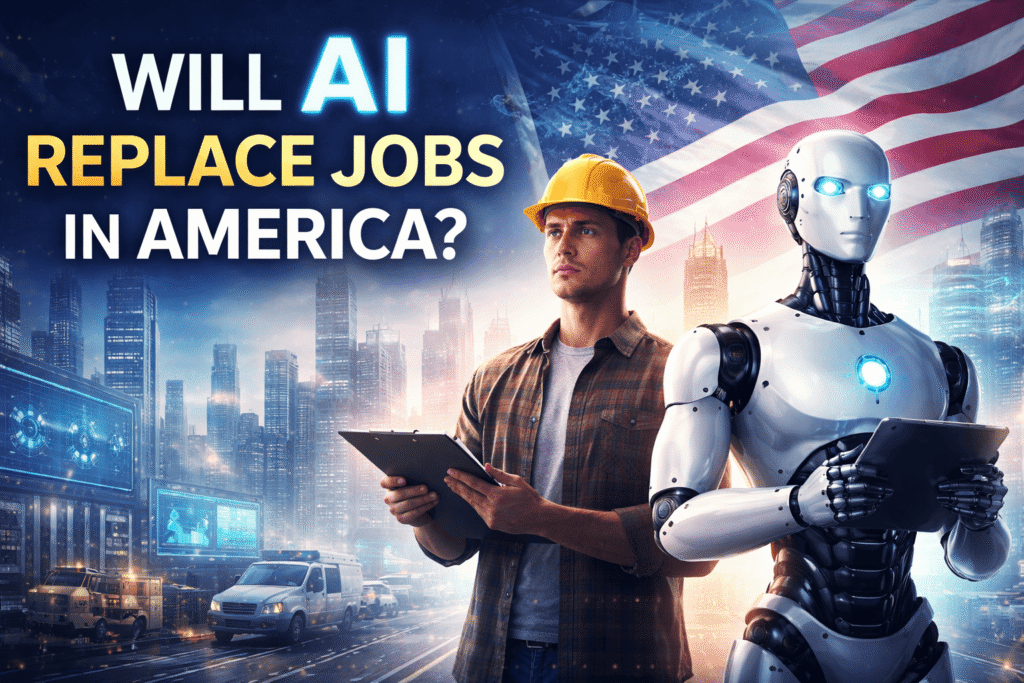
Will AI Replace Jobs in America? The Reality
The answer is not a simple yes or no.
👉 AI will replace some jobs, transform many, and create new ones.
Three Major Impacts of AI
1. Job Replacement
AI can perform repetitive and predictable tasks faster and cheaper than humans.
Examples:
- Data entry jobs
- Assembly line workers
- Basic customer support
2. Job Transformation
Many jobs will not disappear but will change.
Example:
- Accountants using AI tools for faster analysis
- Doctors using AI for diagnosis support
3. Job Creation
AI will create new roles such as:
- AI engineers
- Data analysts
- Cybersecurity experts
So instead of asking only “Will AI replace jobs in America,” a better question is:
👉 “How will AI change jobs in America?”
Jobs Most at Risk from AI
Some jobs are more vulnerable due to their repetitive nature.
1. Manufacturing Jobs
Automation has already reduced factory jobs.
- Robots assemble products faster
- Machines work 24/7 without breaks
2. Retail Jobs
Self-checkout systems and online shopping reduce demand for:
- Cashiers
- Store assistants
3. Customer Service
AI chatbots can handle basic queries.
- Call centers are shrinking
- Automated responses are improving
4. Transportation Jobs
Self-driving technology threatens:
- Truck drivers
- Taxi drivers
- Delivery personnel
5. Data Entry Jobs
AI can process large amounts of data instantly.
Jobs That Are Safe from AI (For Now)
Not all jobs are at risk.
1. Creative Jobs
AI struggles with originality and emotion.
Examples:
- Writers
- Designers
- Artists
2. Healthcare Professionals
Human interaction is essential.
Examples:
- Doctors
- Nurses
- Therapists
3. Skilled Trades
Jobs requiring physical skill are hard to automate.
Examples:
- Electricians
- Plumbers
- Mechanics
4. Leadership Roles
AI cannot replace human judgment and decision-making.
Examples:
- Managers
- CEOs
- Entrepreneurs
Even in these areas, AI will assist—not replace—workers.
How AI is Creating New Jobs
While people ask “Will AI replace jobs in America,” they often overlook job creation.
Emerging Career Opportunities
- AI developers
- Machine learning engineers
- Data scientists
- AI ethics specialists
- Robotics technicians
Growing Demand for Tech Skills
Companies need professionals who can:
- Build AI systems
- Maintain AI tools
- Analyze AI-generated data
Impact of AI on Different Industries
Healthcare
- AI improves diagnosis accuracy
- Reduces administrative work
- Supports doctors, not replaces them
Finance
- AI detects fraud
- Automates transactions
- Enhances risk management
Education
- Personalized learning tools
- AI tutors
- Automated grading systems
Retail
- Inventory management
- Personalized recommendations
- Automated checkout systems
Each sector shows that AI is transforming—not just replacing—jobs.
Benefits of AI in the Workforce
Artificial Intelligence (AI) is transforming the modern workplace in powerful ways. While many people ask, “Will AI replace jobs in America?”, it is equally important to understand the positive impact AI brings to businesses and employees.
AI is not just about automation—it is about improving efficiency, enhancing decision-making, and creating better experiences for both workers and customers.
Let’s explore the key benefits of AI in the workforce in full detail.
1. Increased Productivity
One of the biggest advantages of AI is its ability to significantly boost productivity across industries.
How AI Improves Productivity
AI systems can perform tasks much faster than humans, especially those that are repetitive or data-driven. Unlike humans, AI does not need breaks, sleep, or time off, which allows businesses to operate continuously.
Examples of Increased Productivity
- Automated data entry reduces manual workload
- AI-powered tools can process thousands of records in seconds
- Chatbots handle multiple customer queries simultaneously
- Machines in factories work 24/7 without fatigue
Impact on Employees
Instead of replacing workers, AI allows employees to:
- Focus on high-value tasks
- Spend more time on creativity and strategy
- Reduce time spent on routine work
Real-World Scenario
In offices, AI tools can:
- Schedule meetings automatically
- Sort emails
- Generate reports
This means employees can complete more work in less time with better accuracy.
👉 Result: Higher efficiency, faster output, and improved overall performance.
2. Cost Reduction
Another major benefit of AI in the workforce is cost savings for businesses.
How AI Reduces Costs
AI helps organizations cut expenses in several ways:
1. Lower Labor Costs
Automation reduces the need for large teams to perform repetitive tasks.
2. Reduced Errors
Human errors can be costly. AI systems perform tasks with high accuracy, minimizing mistakes.
3. Operational Efficiency
AI optimizes workflows, reducing wasted time and resources.
4. Predictive Maintenance
In industries like manufacturing, AI predicts machine failures before they happen, saving repair costs.
Example
- AI in accounting reduces errors in financial calculations
- Automated customer service reduces the need for large call center teams
- Smart inventory systems prevent overstocking or shortages
Long-Term Financial Benefits
- Increased profit margins
- Better resource allocation
- Reduced operational risks
👉 Result: Businesses become more profitable and sustainable.
3. Better Decision-Making
AI plays a crucial role in helping businesses make smarter and faster decisions.
How AI Supports Decision-Making
AI systems analyze massive amounts of data in real time. They can identify patterns, trends, and insights that humans might miss.
Key Capabilities
- Data analysis at scale
- Predictive analytics
- Risk assessment
- Real-time reporting
Examples Across Industries
Finance
- AI predicts market trends
- Detects fraudulent transactions
Healthcare
- AI assists in diagnosing diseases
- Recommends treatment options
Marketing
- AI analyzes customer behavior
- Suggests targeted campaigns
Why AI Decisions Are Better
- Data-driven, not emotional
- Faster than human analysis
- More accurate with large datasets
Human + AI Advantage
The best decisions come from combining:
- AI insights (data-based)
- Human judgment (experience-based)
👉 Result: Smarter strategies, reduced risks, and improved outcomes.
4. Improved Customer Experience
Customer experience is a key factor in business success, and AI is revolutionizing how companies interact with customers.
How AI Enhances Customer Experience
AI enables businesses to deliver personalized, fast, and efficient services.
1. Personalization
AI analyzes customer data to provide:
- Product recommendations
- Customized offers
- Personalized content
Example:
E-commerce platforms suggest products based on browsing history.
2. 24/7 Customer Support
AI-powered chatbots and virtual assistants:
- Answer queries instantly
- Provide support anytime
- Handle multiple customers at once
3. Faster Response Time
Customers no longer have to wait for long periods. AI provides quick solutions, improving satisfaction.
4. Consistent Service
AI ensures:
- Uniform responses
- High-quality service
- No human mood variations
Real-World Impact
- Banking apps provide instant assistance
- Online stores offer tailored shopping experiences
- Travel companies use AI for booking and support
Customer Benefits
- Faster service
- Better recommendations
- More convenience
👉 Result: Higher customer satisfaction, loyalty, and retention.
Additional Benefits of AI in the Workforce
Beyond the main advantages, AI offers several additional benefits:
1. Enhanced Workplace Safety
- AI monitors risky environments
- Reduces workplace accidents
- Automates dangerous tasks
2. Faster Innovation
- AI speeds up research and development
- Helps businesses launch products quickly
3. Scalability
- Businesses can grow without increasing workforce proportionally
- AI systems handle increased workloads efficiently
4. Remote Work Support
- AI tools enable collaboration
- Automate communication and workflows
Challenges of AI Replacing Jobs
Despite its benefits, AI brings challenges.
1. Job Displacement
Workers may lose jobs in certain sectors.
2. Skill Gap
Many workers lack the skills needed for AI-related jobs.
3. Income Inequality
High-skilled workers benefit more than low-skilled workers.
4. Ethical Concerns
AI decisions may lack transparency.
How Workers Can Prepare for AI
Instead of fearing AI, preparation is key.
1. Learn New Skills
Focus on:
- Digital skills
- Data analysis
- Programming
2. Embrace Lifelong Learning
Continuous education is essential.
3. Focus on Human Skills
- Communication
- Creativity
- Problem-solving
4. Adapt to Technology
Use AI tools to increase productivity.
Role of Government and Policy
Governments play a crucial role.
Key Responsibilities
- Provide training programs
- Support displaced workers
- Regulate AI development
- Promote job creation
Policies can ensure that AI benefits everyone.
Future of Jobs in America
The future of jobs in America is not a battle between humans and machines—it’s a collaboration. Artificial Intelligence (AI) is transforming the workplace, but instead of completely replacing human workers, it is redefining how work is done.
The modern workforce is moving toward a human + AI partnership, where technology enhances productivity while humans provide creativity, judgment, and emotional intelligence. Understanding this shift is essential to answering the big question:
👉 Will AI replace jobs in America?
The reality is that AI will reshape the job market, not destroy it. Let’s explore this future in detail.
The Rise of Human + AI Collaboration
AI is becoming a powerful tool that supports workers rather than replaces them entirely.
How Collaboration Works
- AI handles repetitive and data-heavy tasks
- Humans focus on decision-making and strategy
- AI provides insights; humans apply judgment
- Machines increase speed; humans ensure quality
Real-World Example
In healthcare:
- AI analyzes medical data quickly
- Doctors interpret results and make final decisions
In business:
- AI predicts trends
- Managers create strategies based on those insights
This collaboration shows that the future is not about job loss—it’s about job evolution.
Key Predictions for the Future of Jobs in America
1. Hybrid Jobs Will Increase
One of the biggest changes in the workforce will be the rise of hybrid jobs—roles that combine human skills with AI tools.
What Are Hybrid Jobs?
Hybrid jobs require:
- Technical knowledge
- Human-centered skills
- Ability to work alongside AI systems
Examples of Hybrid Roles
- Marketing professionals using AI analytics tools
- Teachers using AI-powered learning platforms
- Financial advisors using automated forecasting systems
Why Hybrid Jobs Matter
These roles increase productivity and efficiency while keeping humans at the center. Workers who can use AI effectively will have a major advantage.
👉 This clearly answers part of the question: Will AI replace jobs in America?
No—it will transform them into smarter, tech-driven roles.
2. Automation Will Continue to Grow
Automation is one of the most visible impacts of AI, and it will continue expanding across industries.
What Is Automation?
Automation involves using machines or software to perform tasks without human intervention.
Areas Where Automation Will Expand
- Manufacturing (robotic assembly lines)
- Retail (self-checkout systems)
- Customer service (AI chatbots)
- Logistics (automated warehouses)
Impact on Jobs
- Routine jobs will decline
- Efficiency will increase
- Costs will decrease for businesses
However, automation doesn’t eliminate all jobs—it shifts demand toward higher-skill roles.
Important Insight
While automation replaces repetitive tasks, it also creates demand for:
- Technicians
- Engineers
- System operators
👉 So again, Will AI replace jobs in America?
It replaces tasks, not entire professions.
3. New Industries Will Emerge
AI is not just transforming existing industries—it is creating entirely new ones.
Emerging Industries
- Artificial Intelligence development
- Robotics and automation
- Cybersecurity
- Data science and analytics
- Virtual reality (VR) and augmented reality (AR)
New Job Opportunities
These industries will create millions of new roles, such as:
- AI engineers
- Data analysts
- Robotics specialists
- AI ethics consultants
Economic Growth
As new industries grow:
- Demand for skilled workers increases
- Innovation accelerates
- The economy expands
This is a critical point often overlooked in the debate around Will AI replace jobs in America.
👉 AI is not just taking jobs—it is creating entire career paths that didn’t exist before.
4. Human Skills Will Remain Valuable
Even as AI becomes more advanced, certain human skills will always be essential.
Key Human Skills
- Creativity
- Emotional intelligence
- Critical thinking
- Communication
- Leadership
Why AI Cannot Replace These Skills
AI can process data, but it cannot:
- Truly understand emotions
- Build human relationships
- Think creatively like humans
- Make ethical decisions in complex situations
Examples
- A therapist providing emotional support
- A leader motivating a team
- A designer creating original ideas
These roles require human connection and intuition, which AI cannot replicate.
👉 This reinforces the answer to: Will AI replace jobs in America?
No—because human skills remain irreplaceable.
The Shift from Job Loss to Job Transformation
Instead of focusing only on job loss, it’s more accurate to focus on job transformation.
How Jobs Are Changing
| Old Job | New Version with AI |
|---|---|
| Accountant | AI-assisted financial analyst |
| Teacher | Tech-enabled educator |
| Factory worker | Machine operator/technician |
| Customer support | AI-supported service specialist |
Key Insight
Jobs are not disappearing—they are evolving with technology.
The Role of Education and Skill Development
To succeed in the future job market, workers must adapt.
Important Areas of Learning
- Digital literacy
- AI tools and software
- Data analysis
- Problem-solving skills
Lifelong Learning
The traditional model of “study once, work forever” is changing.
Workers must:
- Continuously upgrade skills
- Stay updated with technology
- Be flexible in career paths
Opportunities for Workers in the AI Era
AI opens doors to new possibilities.
Benefits for Employees
- Higher productivity
- Better job opportunities
- Flexible work environments
- Access to global markets
Benefits for Businesses
- Increased efficiency
- Innovation and growth
- Better decision-making
Challenges to Address
While the future is promising, challenges exist.
1. Skill Gap
Many workers lack the skills needed for AI-driven jobs.
2. Job Displacement
Some workers may lose jobs during the transition.
3. Inequality
High-skilled workers may benefit more than others.
4. Need for Reskilling
Training programs are essential to support workers.
The Big Question: Will AI Replace Jobs in America?
After analyzing all aspects, the answer becomes clear:
👉 AI will not destroy the job market—it will reshape it.
What This Means
- Some jobs will disappear
- Many jobs will evolve
- New jobs will be created
- Human skills will remain essential
Myths About AI Replacing Jobs
Myth 1: AI Will Replace All Jobs
Reality: Only certain tasks will be automated.
Myth 2: AI is Only for Tech Jobs
Reality: AI affects all industries.
Myth 3: AI Will Lead to Massive Unemployment
Reality: New jobs will balance losses.
10 FAQs About AI in the Workforce (Fully Detailed)
1. Will AI replace jobs in America completely?
No, AI will not replace all jobs in America. While it is true that AI can automate certain repetitive and routine tasks, it cannot fully replace human workers across all industries. Jobs that require creativity, emotional intelligence, critical thinking, and human interaction will continue to need people.
AI is more likely to replace specific tasks within jobs, not entire professions. For example, an accountant may use AI for calculations, but human expertise is still needed for financial strategy and decision-making. In the long run, AI will transform the job market rather than eliminate it completely.
2. Which jobs are most at risk due to AI?
Jobs that involve repetitive, predictable, and rule-based tasks are the most vulnerable to AI automation. These include:
- Data entry roles
- Cashiers and retail workers
- Assembly line workers in manufacturing
- Basic customer support roles
- Telemarketing jobs
These positions are easier to automate because they do not require complex human judgment. However, even in these sectors, new roles are emerging that involve managing and maintaining AI system
3. Which jobs are safest from AI?
Jobs that rely heavily on human skills are considered safer from AI. These include:
- Healthcare professionals like doctors and nurses
- Creative professionals such as writers, designers, and artists
- Skilled trades like electricians and plumbers
- Leadership and management roles
- Therapists and counselors
These roles require empathy, creativity, and decision-making abilities that AI cannot fully replicate. While AI may assist in these jobs, it is unlikely to re
4. How is AI creating new job opportunities?
AI is not just eliminating jobs—it is also creating entirely new career paths. As businesses adopt AI technologies, they need skilled professionals to build, manage, and improve these systems.
New job roles include:
- AI engineers
- Data scientists
- Machine learning specialists
- Cybersecurity experts
- AI ethics consultants
Additionally, AI is creating indirect jobs in training, maintenance, and support services. This shows that AI contributes to job growth as well as transformation.
5. What skills are important to succeed in an AI-driven workforce?
To succeed in a world influenced by AI, workers need a mix of technical and human skills.
Technical Skills:
- Basic understanding of AI tools
- Data analysis
- Digital literacy
- Programming (optional but helpful)
Human Skills:
- Creativity
- Problem-solving
- Communication
- Emotional intelligence
Workers who combine both skill sets will have a strong advantage in the future job market.
6. Can AI improve employee productivity?
Yes, AI significantly improves productivity by automating repetitive tasks and allowing employees to focus on more meaningful work.
For example:
- AI tools can analyze data quickly
- Automation reduces time spent on routine tasks
- Employees can focus on innovation and strategy
This leads to:
- Faster work completion
- Reduced workload stress
- Better overall efficiency
AI acts as a productivity enhancer, not just a replacement tool.
7. Is AI expensive for businesses to implement?
Initially, implementing AI systems can be costly due to technology investment, training, and integration. However, in the long term, AI helps businesses save money.
Cost-saving benefits include:
- Reduced labor costs
- Fewer errors and losses
- Improved efficiency
- Better resource management
Over time, the return on investment (ROI) makes AI a cost-effective solution for many companies.
8. How does AI improve customer experience?
AI enhances customer experience by providing faster, smarter, and more personalized services.
Key improvements include:
- 24/7 customer support through chatbots
- Personalized product recommendations
- Quick response times
- Accurate solutions to customer queries
For example, online shopping platforms use AI to suggest products based on user behavior, making the experience more convenient and engaging.
9. Will AI increase unemployment in the future?
AI may cause short-term job displacement, especially in industries with repetitive tasks. However, it is unlikely to cause long-term mass unemployment.
Historically, technological advancements have always created new job opportunities. Similarly, AI will:
- Create new industries
- Generate new roles
- Increase demand for skilled workers
The key challenge is ensuring that workers are trained and prepared for these new opportunities.
10. How can workers prepare for the future of AI?
Preparing for an AI-driven future requires a proactive approach.
Steps Workers Can Take:
- Learn new skills – Focus on digital and technical knowledge
- Stay updated – Keep up with industry trends and technologies
- Embrace change – Be open to new tools and methods
- Invest in education – Take online courses and certifications
- Develop human skills – Improve communication and creativity
Workers who adapt and evolve will not only survive but thrive in the AI-powered workforce.
Final Thoughts
The rapid rise of Artificial Intelligence has undeniably changed the conversation around jobs in America. While concerns about automation and job loss are real, they only tell part of the story. AI is not simply a disruptive force—it is a transformative one.
As we’ve explored throughout this guide, AI is already improving productivity, reducing costs, enhancing decision-making, and creating better customer experiences. At the same time, it is reshaping job roles, demanding new skills, and opening doors to entirely new career opportunities.
The key takeaway is clear: the future belongs to those who adapt.
Workers who are willing to learn, upgrade their skills, and embrace technology will find themselves in a stronger position than ever before. Businesses that responsibly integrate AI will become more competitive and innovative. Governments and institutions that support reskilling and education will ensure a smoother transition for everyone.
Rather than fearing AI, the smarter approach is to understand it, use it, and grow with it.
Conclusion
So, will AI replace jobs in America?
👉 The most accurate answer is: AI will not destroy jobs—it will redefine them.
Some roles will disappear, many will evolve, and countless new opportunities will emerge. The future workforce will be built on collaboration between humans and machines, where each complements the strengths of the other.
Human creativity, emotional intelligence, and critical thinking will always remain valuable—these are qualities AI cannot fully replicate. Meanwhile, AI will continue to handle repetitive tasks, analyze data, and improve efficiency.
In the end, the future is not about humans versus AI—it’s about humans working alongside AI to create a smarter, more productive, and more innovative world.
Those who embrace this change will not just survive—they will thrive in the new era of work.